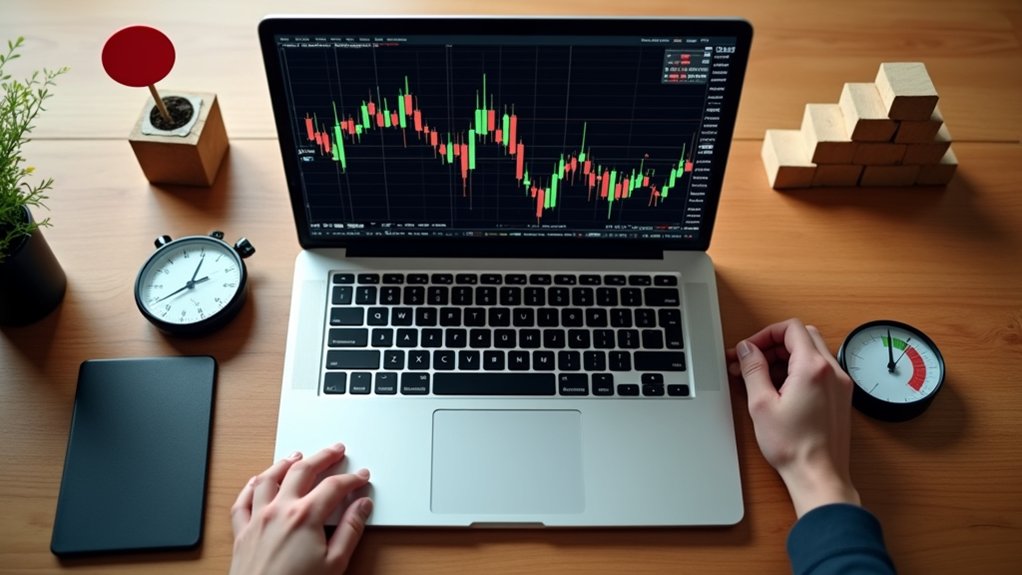
Watching a trade turn green often does more than reassure an investor—it pulls them back to their screen again and again. Researchers studying U.S. and Swedish investors found that positive returns trigger more account checking. In the U.S., a 1% rise in prior returns led to roughly 5-6% more daily logins. Swedish investors showed a smaller bump, about 1%. Interestingly, this checking happened even when it didn't lead to any actual trading.
This pattern connects to something economists call the disposition effect—the tendency to sell winners too early while holding onto losers too long. A study of 10,000 brokerage accounts found gains were realized at a rate of 0.57, compared to just 0.36 for losses. Odean's earlier research found similar results: 14.8% of available gains were cashed in, versus only 9.8% of losses. Lab experiments backed this up too, showing participants were 70% more likely than optimal to sell winning positions.

Why does profit grab attention this way? One behavioral model suggests that good news invites more monitoring because attention amplifies emotional impact. A rising portfolio becomes something people want to watch, not just a number on a screen. Brokerage data confirms many investors log in simply to check, not to trade. This habit may offer emotional comfort or help set new benchmarks for success, even without a clear financial reason. This obsessive monitoring stands in sharp contrast to the realistic pace of building income, since even professional forex traders often earn steady monthly returns without needing to watch every price tick.
But checking more doesn't always mean deciding better. One experiment found students with constant price access invested less and earned 53% lower profits than those who only saw updates every four hours. Another study showed checking investments once a year led to a 70% stock allocation, compared to just 41% for those checking eight times annually.
Trading apps can make this worse. The UK's Financial Conduct Authority tested features like push notifications and prize-linked points on over 9,000 users. Both features increased trading activity—by 11% and 12% respectively.
For investors across Africa's growing digital trading platforms, these findings carry weight. As mobile trading apps expand access to currencies and commodities, understanding why profit draws obsessive attention could matter just as much as market fundamentals.