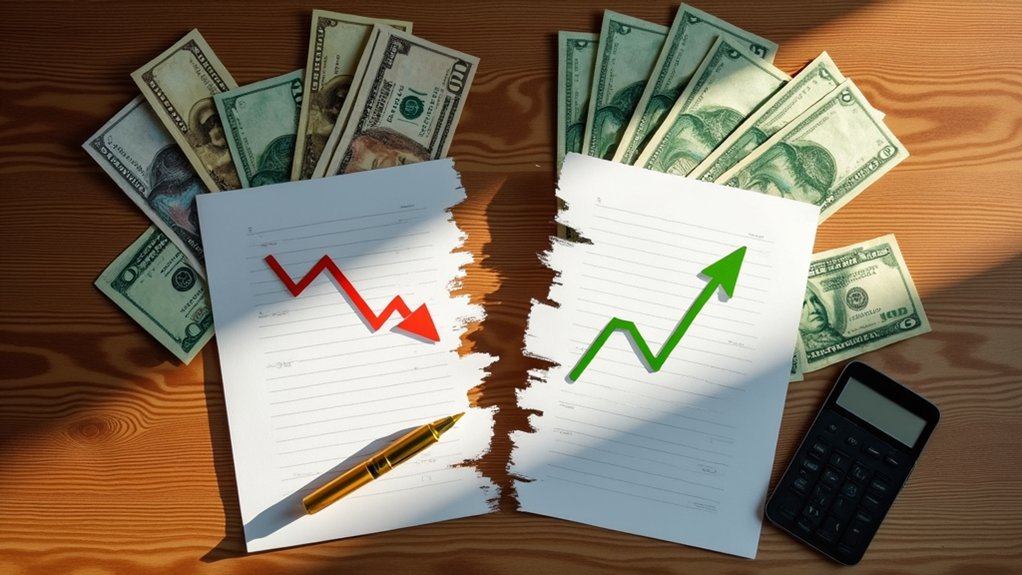
In the span of just six months, the dollar managed to pull off its worst performance in over half a century. The dollar index plummeted 11% in the first half of 2025, marking the sharpest drop since 1973. That's not a typo. The currency that spent 15 years climbing 40% since 2010 suddenly decided gravity still exists.
The dollar's 11% plunge in six months marked its worst showing since 1973—gravity finally reasserted itself.
What triggered this spectacular nosedive? Start with policy chaos. Trump's April tariff announcement sent growth expectations tumbling and the dollar down 7% between April and June. GDP forecasts got slashed from 2.8% in 2024 to just 1.5% for 2025 and a measly 1% for 2026. Consensus estimates dropped from 2.3% to 1.4% during March and April alone.

Then there's the Federal Reserve situation. Interest rates sitting at 5.25-5.5% are expected to crater to 2.5% by the end of 2026. That rate advantage over other major economies? Evaporating fast. The eurozone is at 2%, Japan at 0.5%, China at 3%. When the July jobs report showed only 73,000 new jobs, rate cut expectations accelerated even harder. The relationship between central bank rate decisions and currency values explains why the dollar's trajectory became so predictable once the Fed's dovish pivot became clear.
The drama reached peak absurdity on July 16. Comments about potentially dismissing Fed Chair Powell caused the dollar to drop 1.2% in one hour. One hour. That's the kind of sensitivity that screams instability. Central bank independence becomes critical during such volatility, as markets depend on predictable monetary policy free from political interference.
Meanwhile, European investors holding roughly $8 trillion in U.S. assets started hedging their bets in the second quarter. Foreign flows into U.S. equities weakened dramatically, with some months showing outright selling. Capital reallocation became the new normal.
Inflation adds another layer of mess. Tariffs pushed inflation expectations higher early in 2025, with Morgan Stanley predicting a peak in Q3. Rising import prices hit consumers directly, eroding purchasing power while limiting how much the Fed can actually cut rates. Understanding interest rate decisions is essential for forex traders navigating these turbulent currency movements.
The dollar managed a 3.2% rebound in July, but analysts dismissed it as temporary. Fiscal concerns keep mounting with a $4.1 trillion price tag and questionable revenue projections. Policy uncertainty continues dragging the currency down. After 15 years up, reality finally caught up.