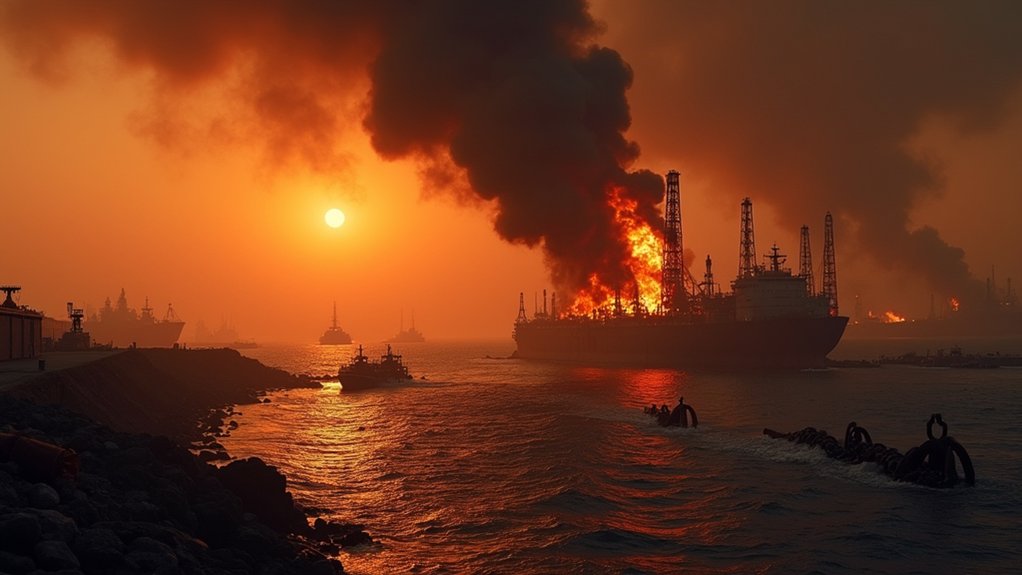

Because Washington now expects Middle East tensions to outlast the current news cycle, Defense Secretary Pete Hegseth has quietly ordered U.S. troop deployments in the region extended into 2027. The move shifts military planning from short-term missions to long-horizon commitments. It covers selected Army airborne units, air defense formations, fighter squadrons, and naval forces rather than the entire regional footprint. There's been no big public announcement. Instead, the change has come through internal orders and letters sent to military families, with some missions—including parts of the 82nd Airborne Division and certain Air Force units—now explicitly coded to run through 2027.
Hegseth has quietly extended U.S. troop deployments into 2027, shifting from short-term missions to long-horizon commitments without public announcement.
The scale of the U.S. presence is already large. About 50,000 troops are stationed across the Middle East, marking the biggest buildup since the 2003 Iraq invasion. Nineteen warships patrol waterways like the Arabian Sea, Eastern Mediterranean, and Red Sea. Fighter squadrons, Patriot and THAAD air defense units, and heavy airlift operations round out the picture. OSINT estimates put total CENTCOM personnel between 40,000 and 55,000, depending on rotation schedules.

Why does this matter? The extension ties directly to the ongoing Iran conflict and worries that instability could stretch well into 2027. Officials want to preserve deterrence and keep rapid strike options available for President Trump, without needing fresh deployments if tensions flare. Fallout from Iran's 2025–2026 protests and internal crackdowns adds to the uncertainty, raising concerns about refugee flows and terrorism risks. Significantly, officials say no major drawdown is planned even if diplomatic progress with Tehran occurs.
For markets, this signals sustained geopolitical risk premiums tied to oil and shipping lanes near the Gulf. Energy-exporting African economies, along with currencies like the Nigerian naira and Angolan kwanza, could see indirect effects if oil prices react to prolonged Middle East friction. Because currency values often hinge on factors beyond oil alone, central banks monitoring these exposed economies may also adjust policy in response to prolonged regional friction. Traders will likely watch for further troop rotation changes, including air defense units shifting from nine-month to 12-month tours, as a signal of how long this posture may last.