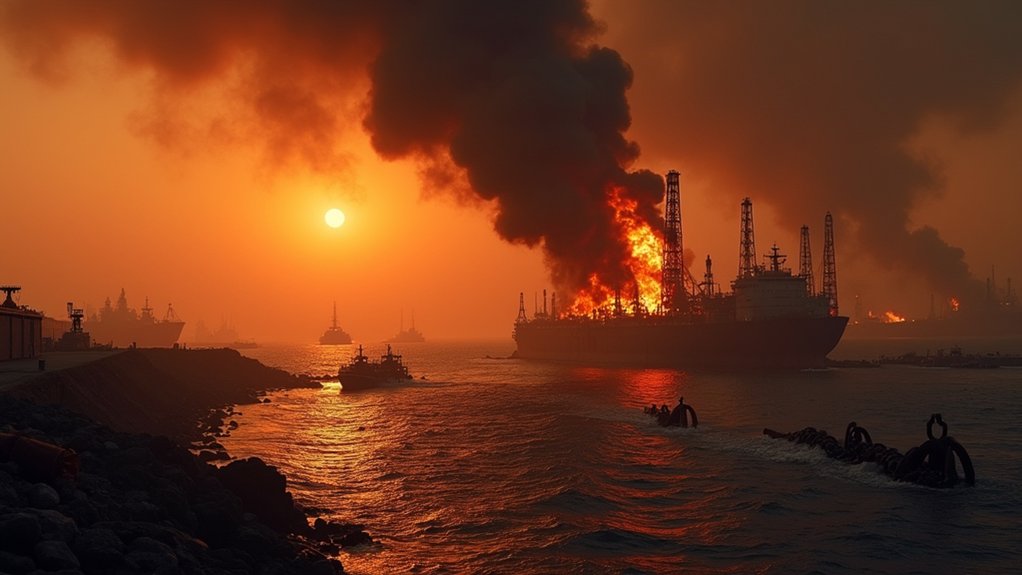

The Middle East exploded into full-scale war on February 28, 2026, when the US and Israel jointly launched Operation Epic Fury against Iran — striking military facilities, nuclear sites, and killing Supreme Leader Ali Khamenei in one swift move. Diplomacy? Dead on arrival. Ongoing nuclear negotiations collapsed the same day strikes began. Washington's message was clear: talking time is over.
The US justified the assault on several grounds — stopping Iran from going nuclear, pursuing regime change, responding to protest crackdowns, and, significantly, targeting Iran's oil and gas resources. That last part raised eyebrows. This wasn't just about nukes. The Pentagon also requested roughly $80 billion to fund operations, signaling nobody expects this to wrap up quickly.

Iran hit back hard. The Islamic Revolutionary Guard Corps announced strikes on every US and Israeli military installation across the Middle East. Bahrain, Qatar, the UAE — all took hits. American bases in Gulf states suddenly looked very exposed. Iran also struck Israel directly, turning what started as targeted strikes into a chaotic, multi-front war.
Then came the Strait of Hormuz. Iran effectively shut it down — warning ships away, boarding merchant vessels, laying sea mines. About 20% of the world's oil passes through that narrow waterway. Closing it wasn't a bluff. It was a gut punch to global energy markets. Washington resumed strikes after Tehran attacked ships there, arguing only military force could bring Iran back to the table. Sure, that sounds familiar.
Yemen's Houthi movement also threatened a Red Sea maritime blockade, piling on the regional chaos. Proxy actors smelled opportunity. The whole region started looking like a powder keg with multiple lit fuses.
This 2026 conflict didn't come out of nowhere. It grew directly from the Gaza war, ran through the Twelve-Day War, and built on the largest US military buildup in the region since 2003. Analysts had warned about exactly this scenario — a regional conflagration triggered by cascading, unresolved conflicts. Nobody really listened. Now everyone's paying attention. North African economies with managed currency systems, such as Morocco, faced particular pressure as the conflict disrupted trade flows, with dirham exchange rate stability becoming a key concern for regional financial authorities. As the conflict rattled global markets, central bank interventions became increasingly critical in stabilizing currencies and preventing the kind of financial panic that typically accompanies large-scale geopolitical crises. Emerging market economies proved especially vulnerable, with monetary policy decisions by institutions like the SARB playing a decisive role in shielding domestic currencies from the worst of the volatility triggered by surging oil prices and investor flight to safety.