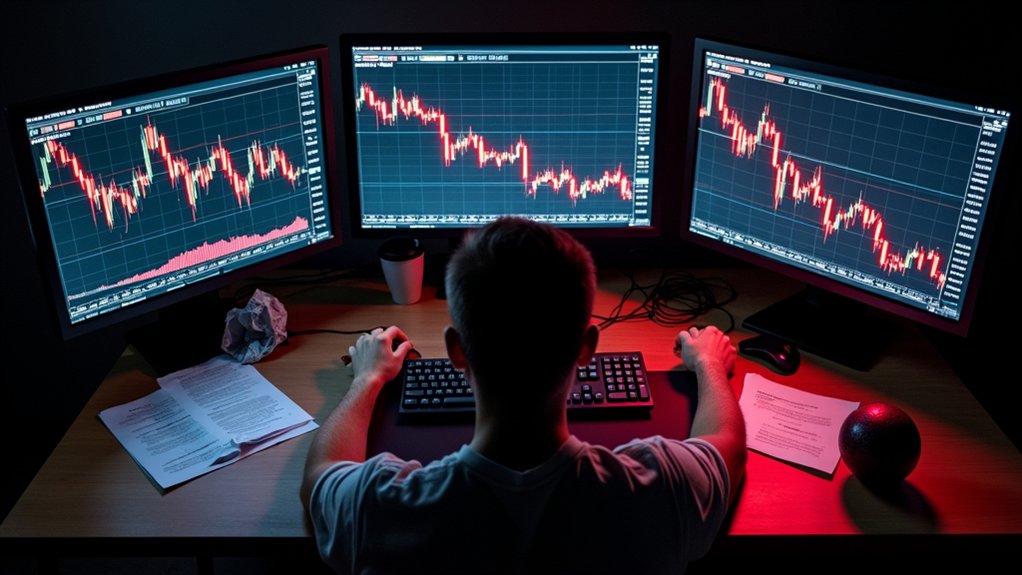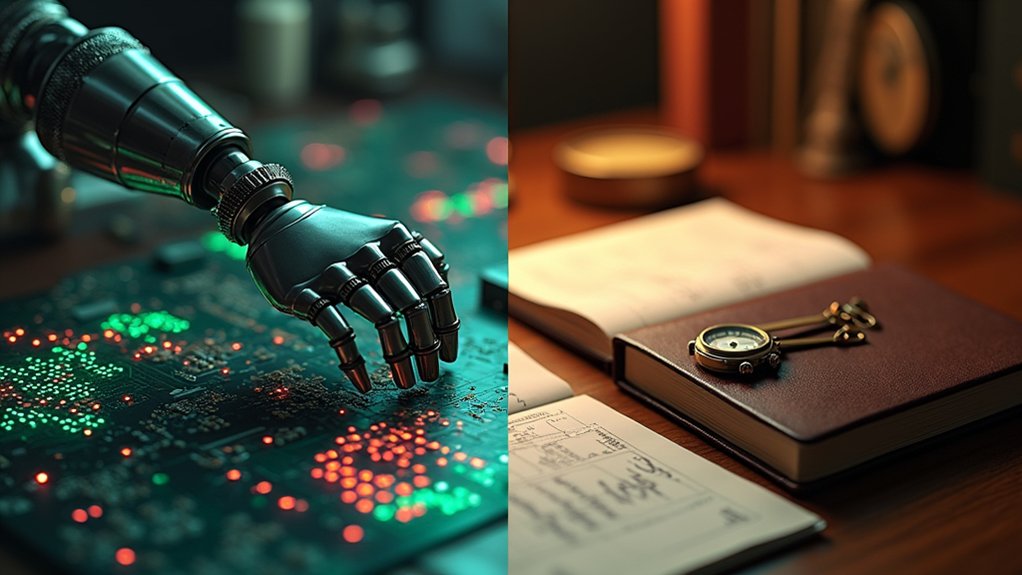
The forex market doesn't care about feelings. It moves at speeds that make human reaction times look pathetic. While manual traders need 10-15 seconds just to process what's happening, automated systems execute trades in milliseconds. That's not a competition. That's a slaughter.
Millisecond execution versus human hesitation isn't a fair fight—it's systematic elimination of manual trading relevance.
Algorithms don't just move faster. They process millions of data points in seconds, scanning multiple markets simultaneously while identifying complex pattern correlations that would take humans days to spot. Manual traders? They're stuck focusing on specific indicators, limited by whatever research they can personally handle. The gap isn't small. It's enormous.

Here's where it gets interesting though. Consistency matters more than raw speed in some scenarios. Automated systems follow pre-set rules without deviation, executing identical trades under similar conditions 24/7. These predefined strategies allow computer programs to maintain discipline that human traders struggle to replicate. No emotions. No second-guessing. No 3 AM panic decisions.
Manual trading varies wildly depending on mood, stress levels, and whether the trader had their morning coffee. Humans are psychologically biased creatures. Algorithms maintain strategy integrity continuously.
But algorithms aren't perfect. They're prone to data or programming biases, and they lack adaptability when unexpected events hit markets. Humans excel at interpreting sentiment and adjusting to weirdness. The catch? Humans also make mistakes under pressure. Lots of them.
The numbers tell their own story. Between 2009 and 2024, AI hedge funds reported 9.8% annualized returns. Automated systems show lower profit per trade but higher frequency. Manual trading yields higher profit per trade with more variability. It's a volume versus precision game.
Market adoption makes the trend clear. 60-75% of US equity trades are algorithmic. In forex, 85% of volume comes from algorithms. Over half of forex trades are automated, with 15% using AI specifically. Among retail traders, 45% use automated strategies. Perhaps most telling: 88% of profitable traders used algorithms before AI even became mainstream. High-frequency trading systems capitalize on minute price discrepancies across currency pairs, executing massive trade volumes that would be impossible for manual traders to replicate.
Cost structures matter too. Automated trading demands high upfront costs but low ongoing expenses. Manual trading starts cheaper but accumulates labor demands and commissions. Neither approach dominates universally. The market's just moving toward machines handling the heavy lifting.
Understanding these performance differences becomes crucial when evaluating professional forex trader earnings, which vary significantly based on the trading approach and tools employed.