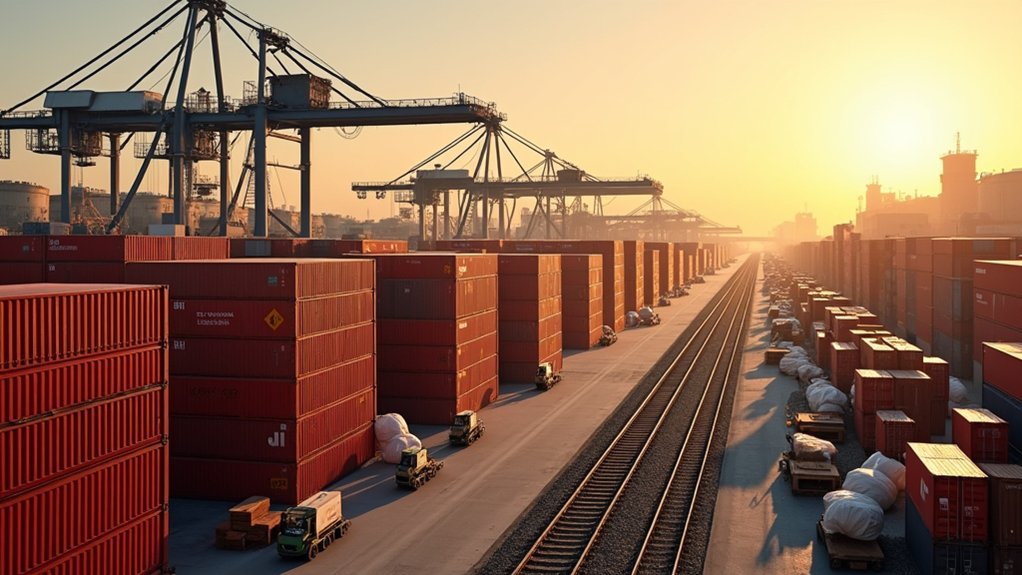

Africa's got a factory problem. Or more accurately, it doesn't have enough factories. The infrastructure gap sits somewhere between $68 billion and $108 billion annually. That's not pocket change. Enter China, building railways, roads, airports, seaports, and energy plants across the continent like there's no tomorrow.
China's filling Africa's $68-108 billion annual infrastructure gap with railways, roads, airports, and energy plants at unprecedented speed.
The numbers tell a story. Bilateral trade hit $282 billion in 2023, making China Africa's largest trading partner. Chinese firms are pouring money into infrastructure, manufacturing, and technology. They're constructing industrial parks and special economic zones while African governments dangle promises of low-cost labor. It's transactional, sure. But it might actually work.

Here's where it gets interesting. China's approach combines aid, trade, and investment rather than the Western model of endless charity that goes nowhere. Through the Forum on China-Africa Cooperation, China committed to addressing infrastructure gaps, training workers, and providing funding. They're building industrial zones and supplying affordable machinery. Ethiopia and Rwanda are already showing results.
The technology transfer piece matters too. Chinese companies offer scholarships and training programs. African workers learn skills, adapt technologies, and start assembling Chinese mobile phones and electric scooters in markets like Kenya. It's basic industrial development, the kind that built every wealthy nation. Nothing revolutionary, just execution.
The projections are wild. Shifting just one percent of China's apparel production to Africa could boost African exports by 47 percent. A five percent shift in Chinese export investments would generate $5.4 billion in additional exports. That's a 233 percent increase. These aren't fantasies—they're mathematical possibilities if the pieces fall into place.
Most African countries benefit from this arrangement, except mature producers like South Africa facing new competition. Ghana and Kenya are developing agro-processing capabilities, moving beyond volatile commodity markets. The Africa Continental Free Trade Agreement creates even more opportunities for Chinese manufacturers to serve local and continental markets. Countries like Angola are also modernizing their foreign exchange trading infrastructure to facilitate these growing commercial relationships with China. Island nations like Mauritius are positioning themselves as financial market hubs with robust regulatory frameworks to support the continent's expanding trade relationships. Seychelles has strengthened its position through the Financial Services Authority, which oversees forex brokers and ensures transparent trading activities across the region.
China even pressured other nations at the 2016 G20 summit to support African industrialization. Whether this transforms Africa into the world's factory remains uncertain. But the alternative—sticking with failed neoliberal prescriptions—hasn't exactly delivered results.