Day traders open and close forex positions within one session, hunting small swings on 1- or 5-minute charts before London or New York wraps. They lean on moving averages, RSI, and MACD to spot entries, slap tight stop-losses to cap damage, and risk only 1–2% per trade—because over-leveraging nukes accounts fast. A demo account (Official Site 🔗) and reliable internet matter more than chasing exotic pairs. Position sizing keeps risk consistent across trades, and a trading journal exposes bad habits before they cost real money. The mechanics unfold below.
Start Day Trading Forex
Forex day trading sounds glamorous until an African trader realizes the game wasn't exactly designed with Nairobi, Lagos, or Johannesburg in mind.

The forex market runs 24/5 globally, but somehow African traders still end up playing on hard mode.
The premise is simple enough: buy and sell currency pairs within a single trading day, pocket profits from small price movements, close everything before sunset. No overnight positions. No rollover fees eating into margins. Just quick moves and quicker exits.
The forex market operates 24 hours a day, five days a week. Sounds perfect for African traders juggling time zones between London, New York, and Asian sessions. Except most brokers with African clients aren't exactly rolling out red carpets.
Liquidity is high globally, sure. Transactions happen fast. But when a trader in Accra or Kampala tries to execute during off-peak hours, spreads can widen like the Sahara.
Leverage is the double-edged sword everyone whispers about. Control larger positions with smaller capital. Amplify gains. Also amplify losses spectacularly.
A trader in Lusaka might access 100:1 or 200:1 leverage through an offshore broker, which sounds thrilling until one bad trade wipes out weeks of progress. Starting at 50:1 makes more sense. Not as exciting. Considerably less catastrophic.
Strategies exist in abundance. Trend following uses moving averages, RSI, MACD to ride whatever direction the market decides.
Breakout trading waits for price to punch through support or resistance, ideally with volume confirmation to avoid false signals that plague thin markets.
Range trading buys at support, sells at resistance when price bounces predictably inside boundaries. Scalping demands dozens of trades daily on 1-minute or 5-minute charts, perfect for liquid pairs like EUR/USD but exhausting for anyone with inconsistent internet in Douala or Dar es Salaam. Mean reversion strategies target prices that have stretched too far from their average, using RSI or Bollinger Bands to catch the snap back in range-bound markets.
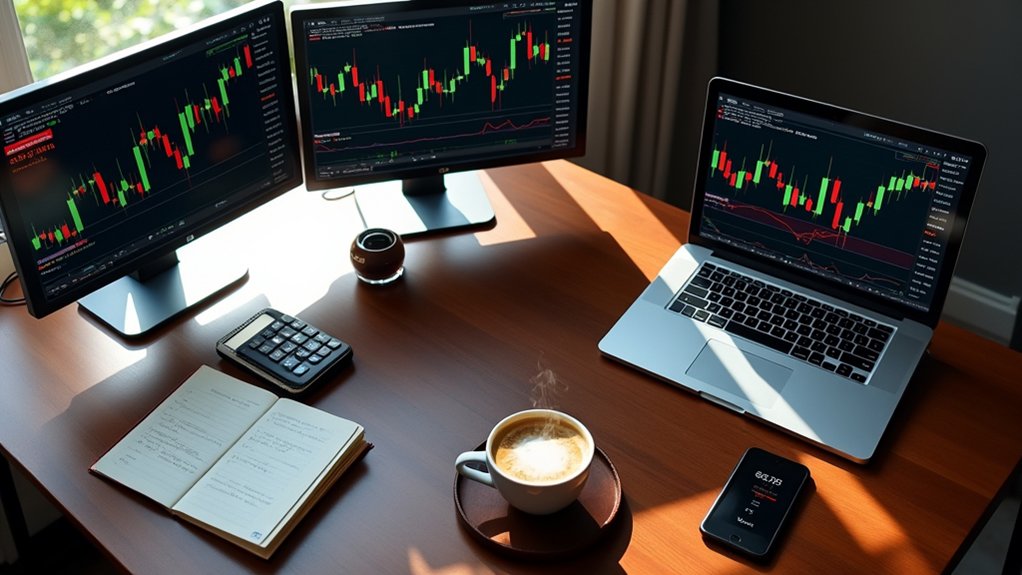
Swing trading holds positions for days, blending technical patterns with fundamental news, which works better when power outages aren't a variable. Candlestick charts reveal the trading range and price action within each time period, helping traders spot reversals and continuation patterns before committing capital.
Tools matter. Moving averages smooth trends. RSI flags overbought or oversold conditions. MACD tracks momentum shifts. Support and resistance levels mark potential entry and exit points. All useful, assuming the trading platform doesn't freeze mid-session.
Risk management separates survivors from casualties. Stop-loss orders cap damage per trade. Risking only 1% to 2% of capital per position keeps accounts breathing after bad streaks.
Diversifying across currency pairs reduces single-market exposure. Position sizing should calculate the exact number of units to buy by dividing dollar risk by entry-minus-stop-loss, ensuring consistent risk across every trade regardless of volatility. Over-leveraging remains the fastest route to account destruction. Keeping a trading journal to document each trade's rationale, entry point, exit point, and emotional state helps identify patterns in both winning and losing streaks.
Setting up starts with choosing a broker that actually accepts traders from Abidjan, Kigali, or Maputo without ridiculous restrictions. Regulatory oversight matters because brokers licensed by recognized authorities offer better protection than unregulated entities operating from anonymous jurisdictions.
Demo accounts let beginners practice without bleeding real money. Understanding foundational knowledge about how currency pairs move and interact prevents costly mistakes when transitioning to live accounts. Some brokers offer micro accounts with minimum deposits as low as $50 to $100, allowing beginners to gain real trading experience without risking substantial capital. Funding the account with truly disposable income matters more than any indicator ever will.
Common Questions
Which Forex Brokers Accept Mobile Money Deposits From East African Countries?
Exness, XM (Official Site 🔗), Pepperstone, FBS, and HFM (HotForex) all accept mobile money deposits from East African traders.
Exness starts at just $1, XM at $5—ridiculously low barriers. They support M-Pesa, MTN Mobile Money, and Airtel Money, the big three in Kenya, Uganda, and Tanzania.
Deposits hit accounts instantly or within hours. Most offer MetaTrader 4/5 and solid regulation.
Mobile money changed the game for millions who never had bank accounts.
Can I Day Trade Forex Legally in Nigeria Without CBN Restrictions?
Day trading forex is legal in Nigeria, but there's no escaping CBN restrictions. The Central Bank licenses brokers, caps Bureau de Change transactions, and enforces strict AML/KYC rules on forex sales above $10,000. SEC oversees online platforms.
Traders face capital gains tax at 10%, mandatory FIRS reporting, and periodic CBN circulars that can limit leverage or methods. Using unregistered brokers? That's illegal. The framework exists—compliance isn't optional.
How Do Power Outages in My Country Affect Open Day Trades?
Open trades stay live on the broker's server when power cuts. Nigeria, Ghana, South Africa—doesn't matter where.
The position runs whether the trader's screen is black or not. Server-side stops and limits still trigger. Client-side tools? Dead. Manual intervention? Impossible. If the market rips and there's no stop-loss, losses pile up unseen.
A UPS, mobile data, or the broker's phone desk become lifelines. Power outages don't close trades—they just blind the trader while risk keeps ticking.
What's the Minimum Capital Needed to Day Trade in South Africa?
In South Africa, brokers let traders start with as little as $1 to $100, depending on the platform. Micro and mini accounts make entry cheap. The Financial Sector Conduct Authority keeps things loose compared to stricter markets, so capital requirements stay flexible. Leverage cranks up buying power, meaning less actual cash needed upfront.
But here's the kicker—low barriers don't mean easy profits. Small accounts plus high leverage equals amplified losses. The math works both ways, unfortunately.
Do African Brokers Offer Lower Spreads Than International Ones for Local Currencies?
No, they don't. African brokers like Exness and AvaTrade (Official Site 🔗) don't systematically offer tighter spreads on local currencies like ZAR or NGN compared to international brokers.
Most low-spread promotions focus on majors like EUR/USD, not African pairs. Spreads on USD/ZAR or other local pairs remain wide everywhere due to lower liquidity—regardless of whether the broker operates from Johannesburg or London.
No published data shows African brokers have a pricing edge on their own currencies. It's a myth.