Forex trading in Togo exists in a regulatory gray zone—no laws ban it, but no one really supervises it either. BCEAO handles monetary policy but doesn't license retail brokers, so traders rely on foreign regulators like ASIC or CySEC while the local framework offers minimal protection. That vacuum turned expensive: CFA 20 billion evaporated in twelve months through two companies, thirty-three executives got summoned, and the trial keeps getting postponed. Social media scams flood platforms promising easy money, withdrawal requests get blocked, and thousands remain stranded. The full story reveals why this market demands serious caution.
Quick Facts That Matter
- No domestic forex regulator exists; traders rely on foreign-licensed brokers with minimal local oversight or investor protection.
- Togo's 59.81% trade-to-GDP ratio amplifies currency exposure, yet infrastructure gaps frequently disrupt execution and market access.
- A CFA 20 billion scam involving 33 executives highlights systemic fraud risks and three-year delays in legal resolution.
- Mobile money dominates deposits, but withdrawal blocking by brokers remains a widespread tactic trapping victim funds.
- Social media floods with get-rich-quick schemes; scammers impersonate officials and exploit weak AML enforcement despite 48-hour reporting rules.
Overview: Forex Trading in Togo
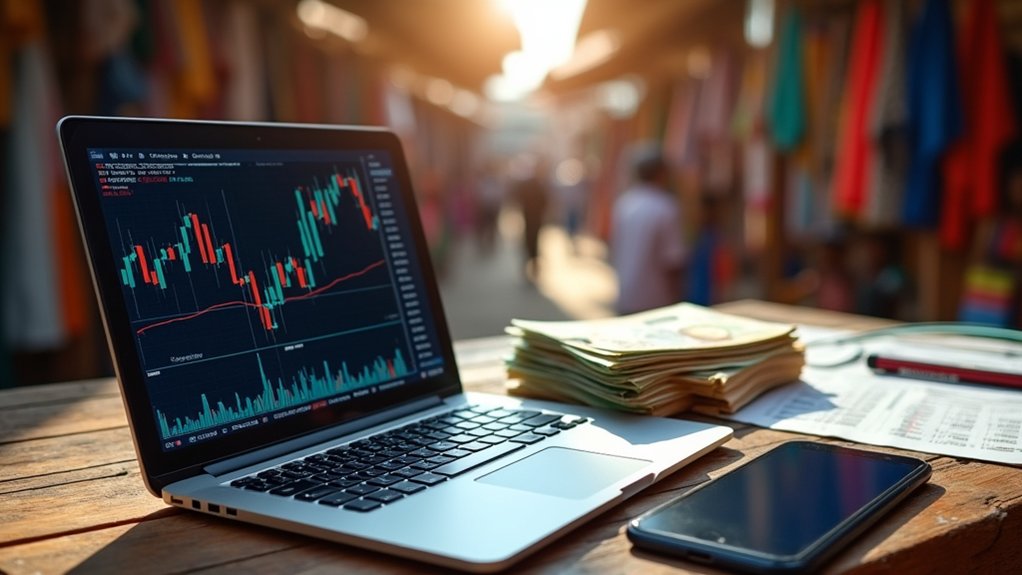
In a small West African nation wedged between Ghana and Benin, retail forex traders navigate a market shaped by the CFA franc and modest economic fundamentals. Togo‘s GNI per capita sits at USD 990. The trade deficit? A hefty USD 805 million, representing 9.91% of GDP. Imports dwarf exports—USD 2,791 million versus USD 1,348 million.

The USD/XOF rate hit 574.28 in June 2025, down from a staggering 913.00 high in November 2024. Digital investment transactions are projected to grow at 5.52% annually through 2030. Trade comprises 59.81% of GDP, making currency movements matter. Neighboring Ghana's cedi fluctuates against the dollar, creating regional currency pair dynamics that Togolese traders monitor closely. The global Forex market, valued at USD 0.93 trillion in 2024, is projected to reach USD 1.16 trillion by 2030, driven by digitization and expanding cross-border commerce.
Is Forex Trading Legal in Togo?

Retail traders in Togo can legally open forex accounts and place currency trades—no laws ban the practice.
Togolese traders face no legal barriers to forex trading—the practice remains unprohibited, though locally unregulated.
The West African Economic and Monetary Union (WAEMU) and OHADA set the legal framework, with BCEAO watching over financial stuff.
But here's the catch: BCEAO doesn't specifically regulate online forex brokers. That's a gap.
So traders end up using platforms overseen by foreign regulators—ASIC, CySEC, FSCA.
It's legal, sure. Just not tightly monitored locally.
The market's growing fast, brokers are pouring in, and nobody's stopping anyone from clicking “buy” or “sell.”
Unlike central banks in some countries that use intervention mechanisms to stabilize currency markets, BCEAO's hands-off approach to retail forex leaves traders navigating largely uncharted waters.
Without specific regulatory licensing, traders face questions about oversight quality and how much protection they actually have if things go wrong.
Who Regulates Forex Trading in Togo?

Who actually watches over forex trading in Togo? Officially, BCEAO—the Central Bank of West African States—holds primary authority.
But here's the thing: they don't really oversee online forex trading. CREPMF, based in Abidjan, coordinates regional financial oversight but offers little practical supervision.
The FSA issues Retail Forex Licenses (dating back to 2007), yet international recognition remains limited.
Bottom line? Regulatory gaps dominate. Investor protections are minimal. Enforcement? Barely documented.
Most reputable brokers serving Togo operate under ASIC or CySEC licenses instead—because local oversight exists more on paper than in practice. Underdeveloped legal frameworks leave traders vulnerable to potential fraud and manipulation by unregulated operators. While BCEAO and CREPMF function as WAEMU institutions managing broader monetary policy, their role in actively regulating retail forex remains notably absent.
How Forex Trading Works in Togo

Despite weak local oversight, forex trading in Togo actually functions—sort of.
Traders open accounts with internationally regulated brokers—ASIC, CySEC, FSCA, whatever. No local licensing exists, so global standards fill the void.
Without domestic regulation, Togolese forex traders rely entirely on foreign licensing bodies to vet their brokers.
Deposits flow through mobile money or bank transfers in CFA francs.
Platforms like MT4 and MT5 work fine when internet connectivity cooperates (big “if”).
Trading happens 24/5 across 70+ currency pairs.
Withdrawals follow standard procedures.
The BCEAO watches from the sidelines, mandating KYC and monitoring suspicious transactions. Sanctions screening applies to forex operations, adding another compliance layer to cross-border currency transactions. CENTIF gets reports within 48 hours. The CFA Franc currency serves both West and Central African nations, creating unique trading dynamics in regional forex markets.
It's functional chaos—regional rules, international brokers, and developmental infrastructure somehow coexisting.
Best Time to Trade from Togo

Timing is everything—especially when trading from a country hovering at GMT with spotty electricity and internet that quits mid-trade.
London session (8:00 AM to 5:00 PM GMT) matches Togo's daylight hours perfectly. The London-New York overlap (8:00 AM to 1:00 PM GMT) delivers peak liquidity, tighter spreads, actual price movement. EUR/USD and GBP/USD go wild during this window.
Tokyo session (12:00 AM to 9:00 AM GMT) exists for insomniacs. It runs with lower volatility than the major sessions, making it suitable mainly for patient scalpers or those trading yen pairs. Understanding trading hours by currency pair helps you match your available time with the moments when your chosen pairs actually move.
New York's closing hours extend action into evening. High volume means better execution. Low volume means watching paint dry while your capital sits idle.
Payments, Deposits and Withdrawals in Togo
Getting money into and out of a forex trading account from Togo requires steering a financial landscape that's part mobile-first revolution, part cash-still-king reality.
TMoney and Mobile Money dominate where banks fear to tread. Cards exist but aren't universal. Brokers like Fusion Markets and IC Markets offer free or low-cost withdrawals—crucial when the XOF floats at roughly 540 per dollar. OFX takes three to five days via direct debit. Afriex moves money in seconds. The gap between those timelines? That's where traders either catch opportunities or watch them evaporate. Speed costs. Slowness costs differently.
PayPal connects Togolese traders to global online payments infrastructure that mobile money can't always reach. Apple Pay and Google Pay add layers of convenience for those with compatible devices, though their footprint remains concentrated in urban centers where card acceptance runs deeper. Traders seeking maximum security often combine bank transfers with e-wallets to balance fund protection against transaction speed.
Taxes, Reporting and Money Rules in Togo
Money moves fast in Togo until the government wants to know where it came from. CENTIF watches everything. Cash transactions over 5 million CFA francs get reported. Period.
The BCEAO enforces regional compliance standards across West Africa, and Togo follows suit. Law No. 2018-16 governs money laundering prevention.
Banks must identify beneficial owners—anyone with 25% ownership or effective control. Records? Keep them ten years. All of them.
Suspicious activity reports go to CENTIF within 48 hours of detection. Forex transactions get sanctions screening. Enhanced due diligence applies to politically exposed persons. Digital KYC is expanding fast.
Forex brokers operating in Togo must implement Know Your Customer procedures to verify trader identities and prevent financial crimes.
Forex Trading Scams and Risks in Togo
How does CFA 20 billion disappear in twelve months?
Two companies—CACESPIC-IF SARL and J-Global Capital—promised stock trading riches during COVID-19. They collapsed faster than they launched. Thirty-three executives got summoned; thirteen showed up. Trial started January 15, adjourned because someone forgot procedural rules. The next hearing is scheduled for February 13. Meanwhile, scammers flood social media—32% of forex fraud originates there. Facebook, TikTok, Instagram, Telegram. The pitch? Get rich quick, minimal effort. Some impersonate U.S. officials using spoofed State Department emails. Others hack accounts, exploit bonuses with bots, launder money through layered transactions. When victims try to withdraw their money, brokers often block withdrawal requests, leaving traders stranded without access to their funds. Thousands lost funds. Public events featured Togolese officials. Three-year investigation. Victims still waiting.
Quick Q and A
Can I Trade Forex Part-Time While Keeping My Regular Job in Togo?
Yes, retail traders in Togo can trade forex part-time while maintaining regular employment. Online platforms enable flexible trading schedules around work hours, though traders must manage time carefully and understand tax obligations on any trading profits earned.
Do Togolese Banks Block Transfers to International Forex Brokers?
Togolese banks don't systematically block forex broker transfers, but require Tax Office departure authorization and transaction documentation for amounts exceeding FCFA 500,000. Banks scrutinize purposes and may delay transfers pending regulatory compliance verification under UEMOA rules.
What Internet Speed Is Needed for Reliable Forex Trading in Togo?
Reliable forex trading in Togo requires 10-15 Mb/s minimum bandwidth. The national average of 29.1-33.03 Mb/s comfortably exceeds this threshold, with GVA provider's 38.6 Mb/s supporting even professional-grade and algorithmic trading activities.
Are Forex Trading Profits Considered Income or Capital Gains in Togo?
The tax classification of forex trading profits in Togo remains unclear, as official guidance from Togolese tax authorities or BCEAO is not publicly available. Retail traders should consult local tax professionals for accurate treatment under Togo's revenue code.
Can I Open a Forex Account Using a Togolese Phone Number?
Most international forex brokers accept Togolese phone numbers for account registration and verification purposes. However, traders should confirm with their chosen broker that Togolese carriers are supported before beginning the account opening process to avoid complications.
The Bottom Line
Forex trading in Togo isn't rocket science, but it's not simple either. The regulatory gaps are real. The payment hurdles exist. Scammers are everywhere. Yet traders who understand the CFA franc dynamics, choose offshore brokers carefully, and navigate mobile money systems can actually participate in global markets. Success requires looking beyond candlestick patterns to grasp Togo's specific financial infrastructure realities. Most traders won't bother. Those who do gain a tangible edge nobody talks about.