Forex trading in Madagascar exists in a legal gray zone—no explicit ban, no local license, and no dedicated regulator watching retail brokers. The Central Bank issues warnings but offers zero formal oversight, leaving traders to fend for themselves with offshore platforms from Australia, Cyprus, or South Africa. Meanwhile, the Ariary has cratered 53 percent against the dollar since June 2023, turning currency chaos into a scammer's paradise. Strict capital controls, patchy infrastructure, and a cash-dominant economy add friction at every step—and the details below reveal what actually works, what doesn't, and where the traps hide.
Quick Facts That Matter
- Retail forex operates in a legal gray zone with no dedicated regulator, leaving traders without consumer protection or formal oversight.
- The Ariary crashed 53% against the dollar since June 2023, creating volatility that attracts both traders and scammers.
- Traders rely on offshore brokers accepting deposits via Mobile Money, often using high leverage up to 1:2000 on MT4/MT5 platforms.
- Strict currency controls require declaring foreign earnings and obtaining Finance Minister authorization for capital transfers outside the interbank system.
- Two out of three retail traders lose money, while weak enforcement and social media recruitment fuel widespread forex fraud schemes.
Overview: Forex Trading in Madagascar
In a country where vanilla and nickel dominate the export ledger, the Malagasy Ariary has been on a volatile ride. The USD/MGA rate hit 4,495.64 by October 2025, down 1.42% in a month but up 2.59% over twelve months. February 2025 marked an all-time low of 4,782.14.

Meanwhile, economic growth inched to 4.2% in 2024, inflation punched up to 8.6%, and vanilla exports surged 224.9% in volume yet earnings still dropped 15.4%. Foreign trade accounts for 61% of GDP. The central bank held its interest rate at 12.00% through September 2025. Malagasy traders looking to access foreign exchange markets face similar regulatory frameworks and broker considerations as participants in neighboring African nations. Most broker platforms rely on JavaScript-enabled browsers to display real-time rate charts and execution tools. Retail forex platforms have noticed.
Is Forex Trading Legal in Madagascar?

Forex trading sits in a legal gray zone that Madagascar has never really bothered to clarify. It's not illegal—nobody's getting arrested for opening a MetaTrader account—but there's zero regulatory oversight. No licensing body, no consumer protection, nothing.
The government basically shrugs and says “go ahead, but you're on your own.” Foreign investors can technically participate under national investment laws, though good luck figuring out which ministry actually cares. The Central Bank of Madagascar has issued warnings about forex risks but offers no formal regulatory framework. Currency controls exist for overseas earnings and transfers, requiring declarations and permissions. Free transfer abroad is permitted without prior authorization for payments related to current operations like profits and dividends, though other capital transactions require Minister of Finance authorization.
Understanding concepts like interest rate differentials becomes especially important when trading in unregulated markets where exchange rate movements can be unpredictable and investor protections are absent.
Who Regulates Forex Trading in Madagascar?

Nobody's minding the store when it comes to retail forex trading. The Central Bank of Madagascar—Banky Foiben'i Madagasikara—handles monetary policy and currency stability. The Ministry of Economy and Finance sets broader rules. Parliament passed banking laws in July 2020 targeting transparency and money laundering. The Commission de Supervision Bancaire et Financière watches banks.
But here's the thing: none of these bodies explicitly regulate retail forex brokers or platforms. They're focused on interbank markets, reserve requirements, and capital flows. For individual traders? There's no dedicated forex regulator. It's a regulatory vacuum. Without established legal frameworks for retail forex activity, traders in Madagascar operate in a space where standard compliance requirements and regulatory protections remain largely undefined.
How Forex Trading Works in Madagascar
Trading currency in Madagascar means traversing a patchwork of old rules and offshore workarounds.
The interbank foreign currency market—known as MID—sets daily rates and acts as gatekeeper. Residents can't wire foreign currency outside that system. Period.
Export Processing Zone companies get a pass, naturally, because exceptions always exist for the connected.
Retail traders sidestep the mess by opening accounts with offshore brokers—Australian, Cypriot, South African—who accept Malagasy clients. Deposits start around $100.
Platforms like MT4 and MT5 handle the actual trading. Leverage climbs to 1:2000 with some outfits. Exness supports Mobile Money services like Mvola, making deposits and withdrawals more accessible for local traders.
The Ministry of Finance technically oversees everything, though enforcement remains opaque. Madagascar lacks a specific local regulatory body for Forex brokers, pushing serious traders toward brokers regulated by reputable international authorities. Choosing a licensed broker helps ensure protection under established legal frameworks, even when operating from offshore jurisdictions.
Best Time to Trade from Madagascar
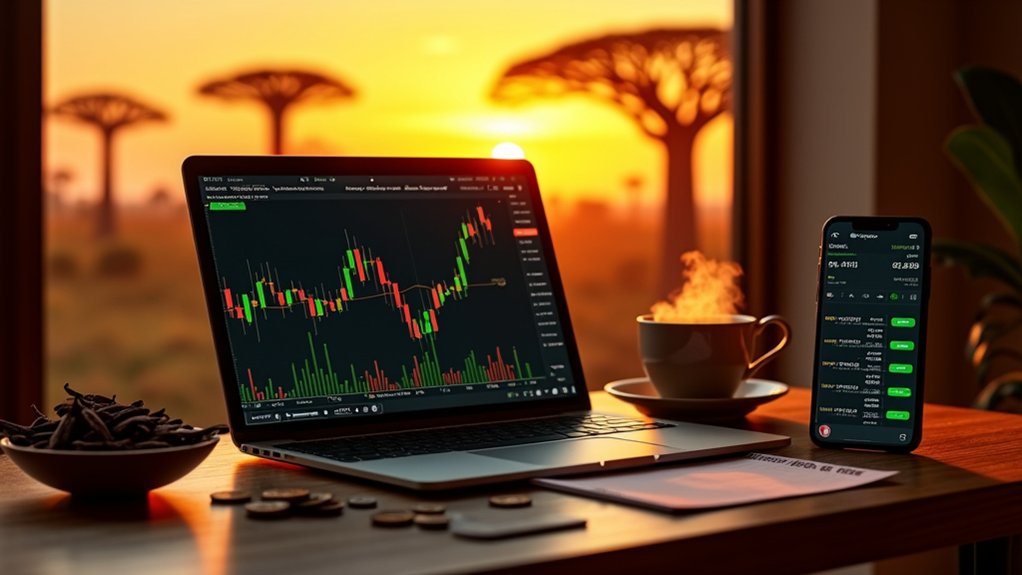
At three in the morning, the Tokyo market jolts awake while most Malagasy traders still sleep. Sydney already flickered to life at five.
London stomps in at ten, overlapping Tokyo until noon—a two-hour sweet spot. Then New York barrels through from four in the afternoon until one the next morning.
The real fireworks? Four to seven in the evening, when London and New York collide. That's where liquidity pools deepest, spreads tighten, and seventy-pip swings become possible. Single sessions limp along at thirty pips.
Avoid the dead zone between one and five a.m.—thin liquidity, fat spreads, misery. Understanding how trading session overlaps amplify volatility helps you position trades when currency pairs actually move, rather than drift.
Payments, Deposits and Withdrawals in Madagascar
Money doesn't move itself, and in Madagascar that truth hits harder than most places.
The Ariary replaced the Franc in 2005. Cash still dominates. Cards work in Antananarivo and Nosy Be, barely anywhere else. EUR and USD exchange easily at airports and banks. NOWPayments handles online transactions; VoguePay and PayPal exist too. Visa cards find more acceptance than most. BNI, BFV-SG, and Bank of Africa run the ATM game. BOSS Revolution and MoneyGram move funds internationally—bank deposits, cash pickup, home delivery. Traditional methods like letters of credit remain in play. Infrastructure is patchy. Understanding the regulatory framework helps traders navigate which platforms operate within legal boundaries and which currency pairs are actually accessible. Plan accordingly.
Taxes, Reporting and Money Rules in Madagascar
Madagascar's tax and regulatory environment for forex trading exists in a gray zone where formal rules meet informal reality.
Madagascar's forex regulations operate in murky territory—strict rules on paper, messy enforcement in practice.
The Central Bank of Madagascar tracks capital movements obsessively. Foreign earnings? Must be declared to the Ministry of Economy and Finance. Repatriation? Mandatory under exchange control rules that tightened after COVID-19 hammered trade flows.
Foreign currency deposits face a punishing 24% reserve requirement versus 11% for Ariary accounts.
June 2023 brought even harsher news: businesses were ordered to close foreign currency accounts entirely. Resident transfers between FX accounts? Blocked unless you secure a regulatory waiver.
Like other African nations, Madagascar's central bank uses intervention mechanisms to stabilize the Ariary against volatile forex pressures, though its limited reserves constrain effectiveness.
The IMF's Article VIII compliance exists mostly on paper.
Forex Trading Scams and Risks in Madagascar
Since June 2023, when the ariary began its brutal 53 percent slide against the dollar, Madagascar has become a hunting ground for forex scammers who spot opportunity in currency chaos.
Fake brokers flash polished websites, forge regulatory licenses, then vanish when traders try withdrawing funds. Signal sellers peddle “insider” predictions built on random noise. Two out of three retail traders lose money even without fraud in the mix.
Weak state institutions can't keep up.
Social media—Facebook, TikTok, Telegram—feeds 32 percent of scam victims straight into the grinder.
The island's largely informal, cash-based economy makes laundering and account takeovers disturbingly easy.
Quick Q and A
Can I Trade Forex Part-Time While Working a Full-Time Job in Madagascar?
Madagascar's employment and forex regulations do not explicitly prohibit part-time currency trading alongside full-time work. However, traders should verify their employment contract restrictions, declare trading income for tax purposes, and guarantee compliance with Central Bank foreign exchange rules.
What Internet Speed Do I Need for Reliable Forex Trading in Madagascar?
A minimum of 2–5 Mbps download speed with stable, low-latency connectivity suffices for retail forex trading platforms. Traders in Madagascar should prioritize connection reliability and backup options over raw speed to avoid order execution delays and platform disconnections.
Do Malagasy Brokers Offer Demo Accounts for Beginners to Practice Trading?
Most brokers serving Madagascar offer free demo accounts for beginners. Platforms like FP Markets, Exness, AvaTrade (Official Site 🔗), and Tickmill provide risk-free practice environments with virtual funds, allowing traders to test strategies on MT4/MT5 without financial exposure.
Which Currency Pairs Are Most Profitable for Traders Based in Madagascar?
No specific profitability data exists for Madagascar-based traders. However, USD/MGA and EUR/MGA pairs offer local relevance given recent appreciation patterns. Major pairs like EUR/USD remain popular due to liquidity, tight spreads, and availability through authorized brokers.
Are There Local Forex Trading Communities or Mentors Available in Madagascar?
Information about established local forex trading communities or mentors in Madagascar remains limited. Retail traders may need to rely on international online forums, broker-provided education, and global trading communities rather than locally-based mentorship networks or physical trader groups.
The Bottom Line
Madagascar's forex scene is messy, unregulated, and full of gaps. Traders deal with sketchy brokers, clunky payment routes, and zero official guidance on taxes or legality. Internet cuts out. The ariary bounces around. Scams lurk everywhere. Yet people keep trading—through mobile money, offshore platforms, whatever works. It's resourceful, risky, and completely unsupported by any functioning regulatory framework. For now, it's the Wild West with smartphone screens and unreliable Wi-Fi.