Beginners need to grasp four main order types in forex: market orders execute instantly at current prices but can slip during volatile sessions, limit orders trigger only at specified prices to avoid overpaying, stop orders catch breakouts or cut losses automatically, and pending orders let traders set conditions then walk away. Each serves a different purpose. Market orders prioritize speed over price control, limits lock in exact levels, stops protect capital or chase momentum. The distinctions matter because choosing wrong can cost real money fast, and mastering these basics separates guesswork from strategy in foreign exchange markets worldwide.

How does a trader in Lagos or Nairobi actually buy or sell a currency pair without watching the screen every second? Order types. That's the answer. They're the instructions telling a broker what to do when certain conditions hit. Not glamorous, not complicated, but absolutely necessary for anyone starting out in Forex across Africa.

Order types are simple instructions to your broker—not glamorous, but absolutely necessary for trading without constant screen time.
Market orders execute immediately at whatever price the market offers right now. No waiting. No specific price target. A trader clicks buy or sell, and the trade happens instantly at the best available rate. Simple enough for beginners, which explains why new traders in Accra or Cairo use them constantly. The catch? Slippage. During volatile sessions—say, when the South African rand lurches after a political announcement—the execution price might differ from what appeared on screen moments earlier. Fast-moving markets don't wait politely. These immediate transactions occur at the current market price, making them the fastest way to enter or exit a position in foreign exchange trading.
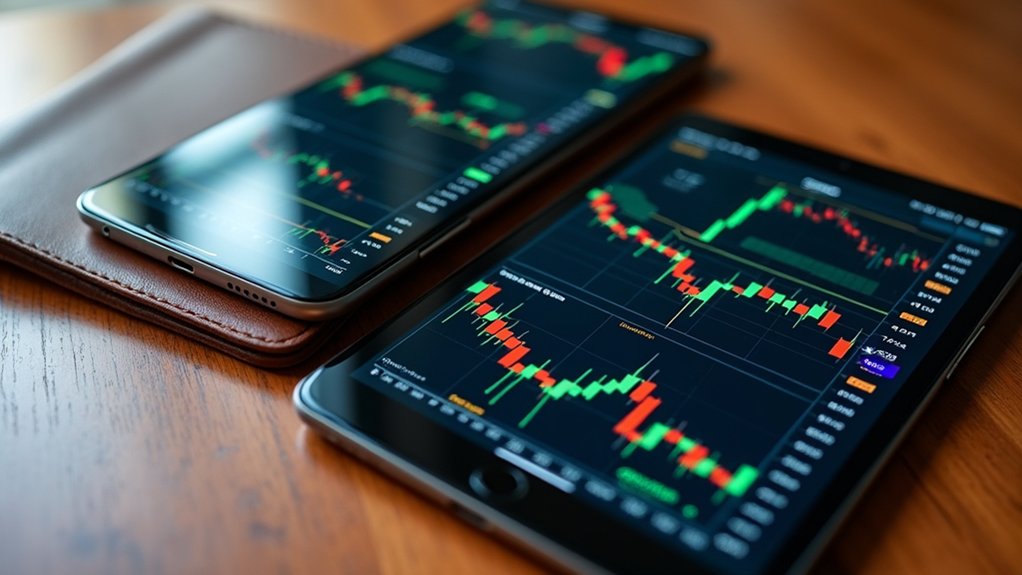
Limit orders flip that script entirely. Here, the trader sets a specific price: buy this pair only if it drops to this level, or sell only if it climbs to that level. Buy limits cap the maximum purchase price. Sell limits set the minimum sale price. Great for patience, useless for urgency. If the USD/ZAR never reaches the limit price a Johannesburg trader set, the order never executes. Period. But there's no slippage, because the fill only happens at the specified price or better. This automatic execution happens when the market reaches the trader's predetermined level or moves beyond it favorably. Limit order markers appear directly on trading charts at the specified level, giving traders a clear visual reference of where their pending orders wait.
Stop orders are where things get tactical. A buy stop opens a long position when price rises above a set level. A sell stop opens a short when price falls below a point. Traders in Kampala or Tunis use these to catch breakouts or add to positions already running. Once triggered, though, a stop order becomes a market order—meaning slippage can creep back in during chaotic sessions. These conditional orders execute automatically when a currency pair reaches the predetermined price level, removing the need for constant monitoring.
Stop-loss orders deserve their own mention because they're pure survival tools. Attach one to any open position, and it closes automatically at a specified price to limit damage. Protecting capital matters everywhere, but especially in markets like Nigeria or Kenya where leverage amplifies both wins and wipeouts. Trailing stops take this further by adjusting automatically as price moves favorably, locking in profits without manual babysitting.
Pending orders—buy stop, sell stop, buy limit, sell limit—sit idle until conditions align. A trader in Dakar or Kigali can set them up and walk away. No screen-staring required. But they demand understanding of market structure and key price levels, otherwise it's just guessing dressed up as strategy. Emotional trading shrinks when entries and exits are predefined. That's the real benefit. More advanced traders also use time-in-force instructions like Good-Till-Cancelled or Fill-or-Kill to control exactly how long orders remain active and under what conditions they execute. Practice each order type in a demo account (Official Site 🔗) first before risking real money on live trades.
Common Questions
Can I Place Forex Orders During African Market Hours With Local Brokers?
Yes, African traders can place forex orders 24/5 through local brokers during standard business hours and beyond. South African brokers offer round-the-clock order placement aligned with global sessions—Sydney, Tokyo, London, New York.
The Johannesburg Stock Exchange closes at 16:40, but forex brokers keep running. Orders execute when conditions hit, even outside active hours. Stop-losses work while traders sleep.
Local public holidays? Brokers still provide access during international sessions. The market doesn't care about geography.
Do African Brokers Charge Higher Fees for Stop-Loss and Take-Profit Orders?
Most African brokers don't charge extra fees for stop-loss or take-profit orders. Period.
The costs are already baked into spreads or commissions per lot, depending on account type. ECN accounts from brokers like Pepperstone or FXTM operating in Africa charge commissions, but that's standard—not a sneaky fee for using stop-loss.
South African FSCA-regulated brokers must disclose everything anyway. So no, African traders aren't getting gouged for basic order types. Fees come from elsewhere.
Which Order Types Work Best When Trading Nigerian Naira or South African Rand?
Market orders work fast when the Naira or Rand suddenly moves—no waiting around.
Stop-loss orders help Nigerian and South African traders cut losses when volatility spikes, which happens often.
Limit orders let traders set their price and walk away, useful given unreliable internet in some regions.
Trailing stops can lock gains as the Rand climbs.
Buy limits work when the Naira dips predictably.
Really, it depends on whether the trader expects chaos or calm—and in Africa, chaos usually wins.
Can Unreliable Internet in My Country Affect Pending Order Execution?
Yes, and it's a massive problem across Africa. Unreliable internet in Nigeria, Kenya, Ghana, Zimbabwe—anywhere really—can delay order execution, cause trades to fill at worse prices, or fail completely.
A pending stop-loss might not trigger when needed. Orders get stuck. Connections drop mid-trade. Some traders in Lagos or Nairobi keep backup mobile data or use multiple ISPs. Others trade only when power and connectivity are stable. It's real risk that costs real money.
Do Mobile Trading Apps in Africa Support All Order Types Equally?
No, they don't. MT4 and MT5 apps generally cover the basics—market, limit, stop, trailing stop.
But proprietary platforms like AvaTradeGo or Plus500 often skip advanced stuff like OCO orders. Some brokers simplify interfaces for mobile, cutting features available on desktop.
South African regulations or leverage caps can further restrict what's enabled. Binary-focused apps barely qualify as full FX platforms.
Connection issues across the continent make conditional orders riskier anyway. It's uneven coverage, plain and simple.