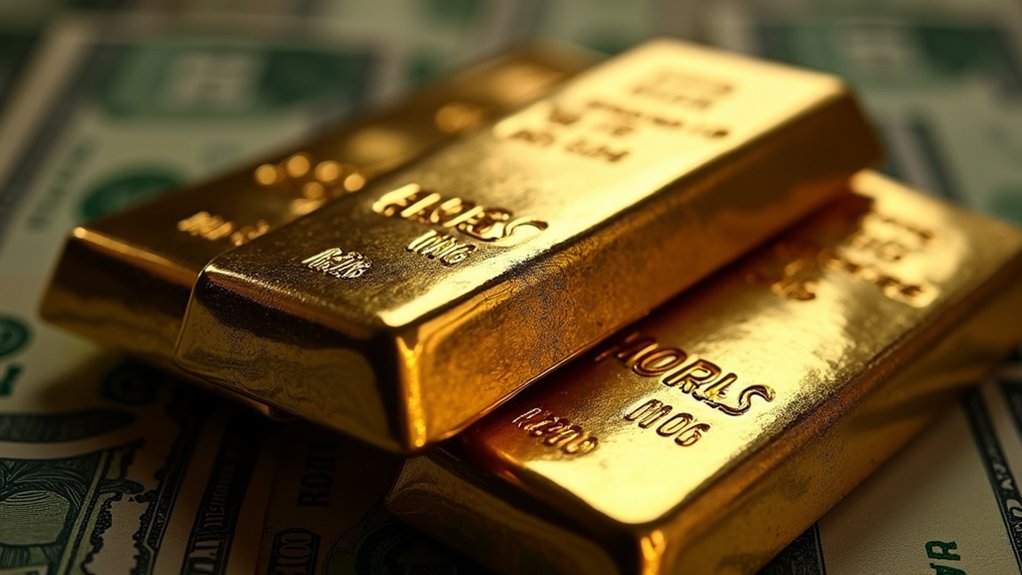

When will gold catch a break? The precious metal slipped nearly 4% to $5,075 after a four-day climb, marking a rough 3% weekly decline that has traders wondering if the bulls have any fight left. Gold briefly dipped below $5,100 as the U.S. dollar flexed its muscles, and despite escalating geopolitical chaos, the greenback's strength is overpowering gold's traditional safe-haven appeal.
The backdrop is messy. Iran blocked the Strait of Hormuz, launched attacks on U.S. bases, and the U.S.-Israel tag team responded with joint strikes on Iranian leaders. Drone attacks near the U.S. Embassy in Riyadh added fuel to the fire. Usually, this kind of mayhem sends gold soaring. Not this time. The dollar isn't playing along.

Rising yields and reduced rate-cut expectations are keeping gold pinned down. The CME FedWatch Tool shows 60% odds the Fed holds rates steady through June, and inflation fears are creeping back as oil prices surge. The Fed has flexibility to pivot, but the ECB and BoE remain rigid, which keeps the dollar elevated and gold under pressure. Central bank interventions in currency markets continue to play a decisive role in maintaining the dollar's dominance, even as traditional risk-off assets like gold struggle to gain traction. Traders rolling forward their currency positions through Tom/Next swaps are paying close attention to these dollar dynamics as overnight financing costs reflect the currency's persistent strength.
Technical signals paint an interesting picture. The RSI sits at 58.485, suggesting buy territory, while the MACD at 20.15 also flashes bullish. But the StochRSI at 96.999 screams overbought, and with the ATR at 27.10, volatility remains high. Translation? Buckle up.
Gold is currently trading around $5,350 to $5,365 as of March 3, 2026, but the journey has been brutal. It fell from a record $5,600 down to $4,770 earlier, and now the critical psychological support at $5,000 is being tested. Immediate support sits between $5,050 and $5,000, with deeper levels at $5,298 near the 50-day moving average and $5,261.
On the upside, $5,200 acts as short-term resistance. Break above that and $5,260 comes into play. Stronger resistance lurks near $5,311 and $5,371 to $5,388. If $5,000 holds, a recovery to $5,180 is possible. J.P. Morgan still predicts gold hitting $5,000 by Q4 2026, and with ETF demand and oil prices elevated, bulls might have one more shot. Understanding forex market volatility is crucial here, as currency fluctuations and central bank policies continue to drive gold's price swings alongside traditional economic factors.