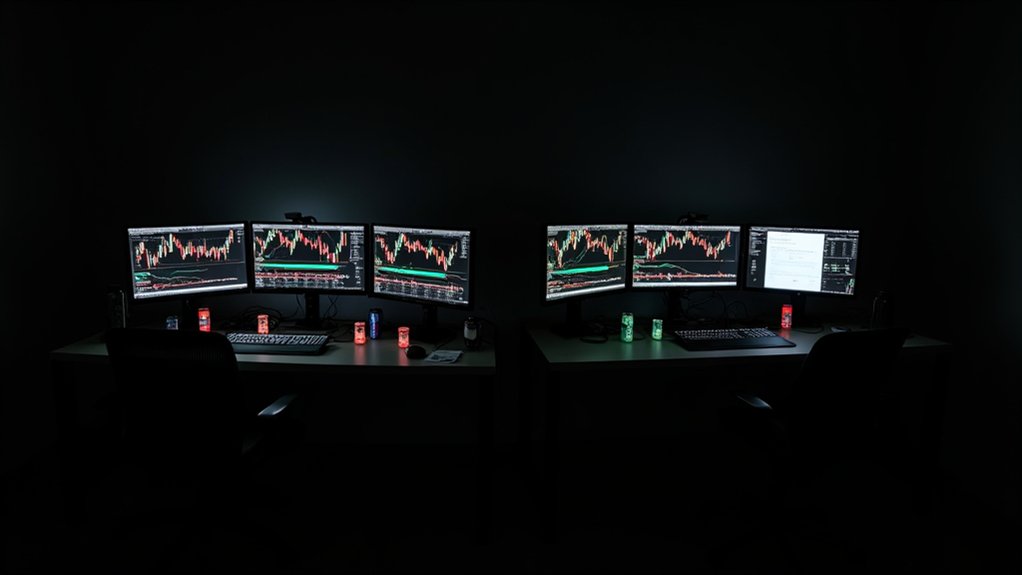
Trend and range markets represent two distinct types of market behavior that every trader must recognize. A trend market moves consistently in one direction—up or down—driven by strong momentum and sustained buying or selling pressure. A range market, in contrast, oscillates sideways as price bounces between established support and resistance levels, showing indecision and balance between buyers and sellers. Knowing which condition the market is in helps traders choose the right approach: trend-following methods thrive in trending markets, while mean-reversion strategies fit better in ranging ones.
In short: trend markets move with momentum in one direction, while range markets fluctuate sideways between key levels.

Understanding these market conditions is essential for price action trading, as different strategies work better in trending versus ranging environments. Traders can use Market Profile analysis to identify value areas and assess whether price is accepting or rejecting certain levels, helping distinguish between trend development and range-bound consolidation.
Example in Action
On the USD/ZAR pair, imagine the price has been bouncing between 17.5000 (support) and 17.8000 (resistance) for two weeks—this is a clear range market where you could buy at 17.5000 and sell at 17.8000, capturing 300 pips repeatedly.
One Monday morning, the price suddenly breaks above 17.8000 with strong volume, closes at 17.9500, and ADX jumps from 18 to 32—the market has now shifted into an uptrend. Since this breakout occurred during the London opening session when forex volatility increases, the move was supported by higher liquidity and stronger momentum.
If you continue trying to sell at the old resistance of 17.8000 expecting a reversal, you'll face losses as the price keeps climbing to 18.2000 and beyond.
The key lesson: when USD/ZAR was ranging, you traded the boundaries, but after the breakout with rising ADX, you must switch to buying pullbacks in the direction of the new uptrend. The ADX measures trend strength to help you distinguish between trending conditions where breakout strategies work best and ranging markets where mean reversion is more effective.
Why It Matters
For traders across Africa—from Lagos to Nairobi, Johannesburg to Cairo—getting market identification wrong doesn't just hurt performance.
It kills accounts. Trend strategies in range markets? Whipsawed to death. Range tactics during breakouts? Steamrolled. The Nigerian trader watching USD/NGN, the Kenyan tracking EUR/USD—both face identical pain when they misread conditions. Wrong market type means wrong indicators, wrong stops, wrong everything. Recognition isn't optional.
Common Questions
How Do African Currency Pairs Behave Differently in Trending Versus Ranging Markets?
African currency pairs display extreme volatility in trends, often driven by commodities and political events, while ranging markets feature wider spreads and unpredictable breakouts. Lower liquidity amplifies both conditions, demanding heightened risk management compared to major pairs.
Which African Brokers Offer Better Tools for Identifying Range-Bound Markets?
MetaTrader-based brokers like Fusion Markets, IC Markets, and Exness offer African traders superior range-identification tools through custom indicators, RSI, Bollinger Bands, and horizontal line drawing. Dominion Markets and FP Markets provide educational resources specifically addressing range-bound strategies for local market conditions.
Do Power Outages Affect Range Trading Strategies More Than Trend Strategies?
Yes, power outages disproportionately harm range trading strategies across Africa. Range systems depend on frequent, precise entries and exits at support-resistance levels, so brief disconnections cause multiple missed reversals—unlike trend strategies with fewer, wider-stop signals that tolerate short interruptions.
Can Mobile Trading Apps Reliably Detect Trend Reversals in African Forex Markets?
Mobile apps can detect reversals using RSI, MACD, and patterns, but African market illiquidity, connectivity issues, and political volatility reduce reliability. Multi-indicator confirmation and locally-tuned algorithms improve accuracy, yet false signals remain frequent across regional currency pairs.
How Does Low Liquidity in African Sessions Impact Range Breakouts?
Low liquidity during African trading hours starves breakouts of volume needed to sustain momentum. Thin order books cause false signals, widened spreads trigger slippage, and institutional absence means most breakout attempts fail or reverse quickly into range.
« Back to Glossary Index