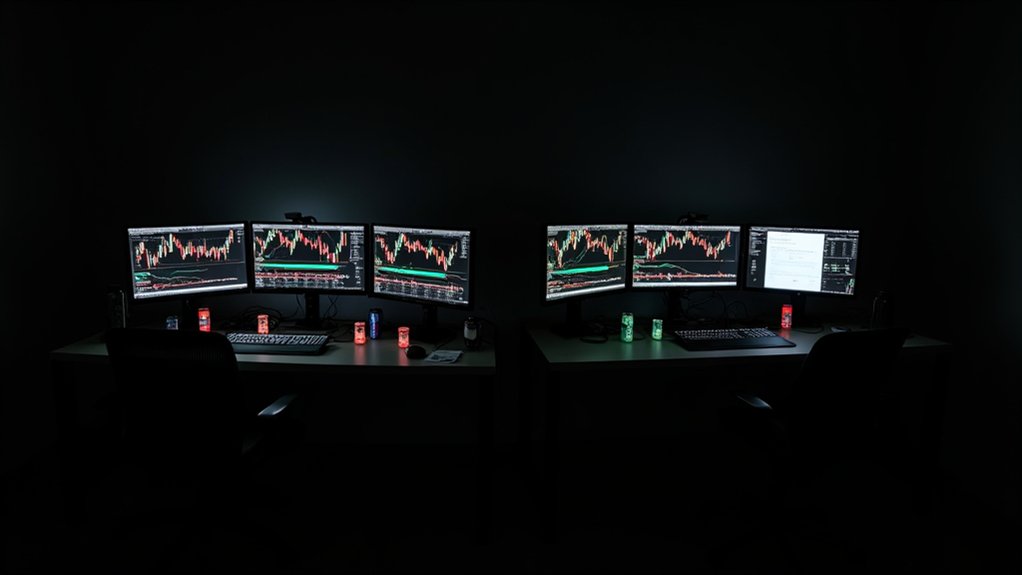
A dealing desk broker acts as the counterparty to your trades, meaning when you buy, they sell to you, and vice versa. These brokers create their own internal market and may set their own prices within a certain range of actual market rates.
Dealing desk brokers take the opposite side of your trades, creating an internal market with their own pricing structure.
In contrast, a no dealing desk broker routes your orders directly to liquidity providers like banks and other financial institutions without taking the opposite side of your trade. Think of it like buying a car: a dealing desk is like purchasing from a dealership's existing inventory, while no dealing desk is like the dealer finding your specific car from various wholesalers. These execution models determine how efficiently your orders are processed and filled in the market.

No dealing desk brokers typically use either Straight Through Processing (STP) or Electronic Communication Network (ECN) models to connect traders with external liquidity sources. The two main no dealing desk models differ in how they connect to liquidity providers, with ECN offering direct market access and STP routing orders through the broker's network. Direct Market Access (DMA) systems provide another execution option that allows traders to interact directly with the order books of liquidity providers.
In short: Dealing desk brokers trade against you as the counterparty, while no dealing desk brokers pass your orders directly to external market participants.
Example in Action
You want to buy 10,000 USD/ZAR at 18.5000.
With a dealing desk broker, they take the opposite side of your trade internally—you buy from them at 18.5000, and they might hedge it later or match it with another client selling.
With a no dealing desk broker, your order is routed directly to liquidity providers in the interbank market who offer 18.5000, so you're trading with banks or other institutions, not the broker. These liquidity providers often execute trades through major electronic platforms like EBS and Reuters Matching, which connect institutional participants using sophisticated order matching systems.
The dealing desk broker is your counterparty and profits from your loss, while the no dealing desk broker simply passes your order through and earns from spreads or commissions. In contrast, multi-dealer platforms aggregate liquidity from multiple institutions simultaneously, giving traders access to competitive pricing from various sources rather than relying on a single counterparty.
Why It Matters
Understanding execution models isn't just academic theory for African traders—it directly affects whether orders get filled at the price displayed or mysteriously shift when the “Confirm” button is pressed.
DD brokers can requote or reject orders during volatility, causing missed opportunities. NDD models eliminate human intervention, reducing manipulation risk. The difference between milliseconds and manual delays? Real money.
Execution transparency determines whether traders in Lagos, Nairobi, or Johannesburg get fair market access or face hidden obstacles.
Common Questions
Which African Brokers Openly Disclose Their Execution Model to Nigerian Traders?
No African brokers outside South Africa prominently disclose execution models publicly to Nigerian traders. Nigerians typically access international brokers like Pepperstone, IC Markets, and FP Markets, which provide execution transparency under foreign regulations, not local African firms.
Do Dealing Desk Brokers in Kenya Charge Different Spreads Than International Brokers?
Yes, Kenyan dealing desk brokers typically charge wider fixed spreads than international ECN/STP brokers, which offer tighter variable spreads starting from 0.0–0.1 pips on major pairs, though standard accounts show smaller differences around 1–1.5 pips.
Can Ghanaian Traders Access True ECN Brokers With Local Payment Methods?
Yes, Ghanaian traders can access true ECN brokers like FP Markets, Pepperstone, and RoboForex. These brokers accept mobile money (MTN, Vodafone), Visa, Skrill, and Neteller, with some supporting direct GHS deposits and withdrawals for convenience.
How Do South African Regulations Affect Dealing Desk Versus No Dealing Desk Models?
FSCA regulation treats both dealing desk and no dealing desk brokers equally, requiring identical capital standards, client fund segregation, transparent execution disclosure, leverage caps at 30:1, and all-encompassing compliance controls regardless of execution model employed.
Are Requotes More Common With African-Based Brokers Using Dealing Desk Execution?
Yes, requotes occur more frequently with African-based Dealing Desk brokers, particularly unregulated or loosely regulated operators. Infrastructure challenges, limited liquidity, and weaker oversight contribute to higher requote rates compared to regulated NDD brokers operating across Africa.
« Back to Glossary Index