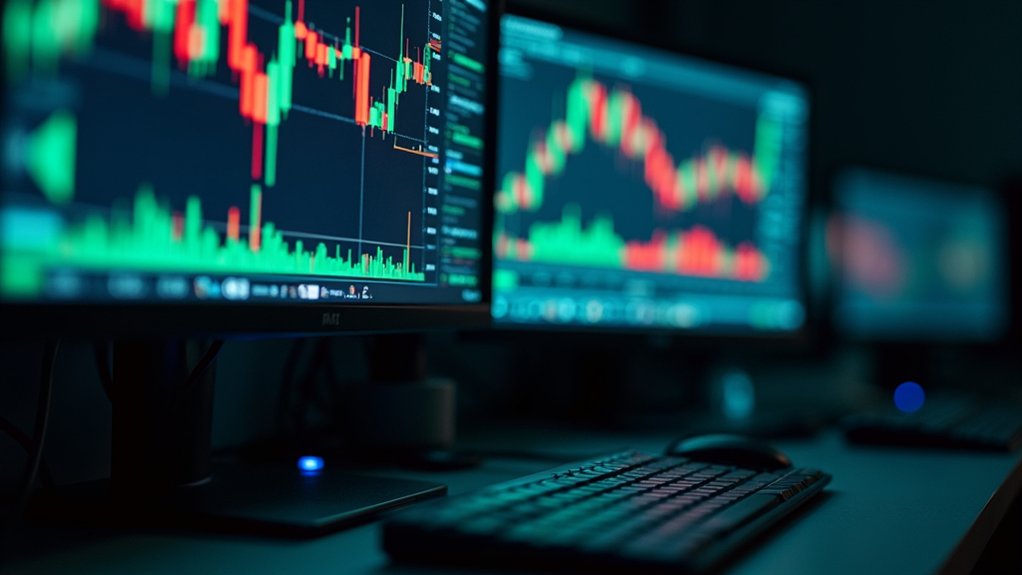
Day trading in forex means opening and closing currency trades within the same trading day. Day traders buy and sell currency pairs multiple times during market hours, aiming to profit from small price movements. They never hold positions overnight.
Day trading forex involves executing multiple currency trades during market hours and closing all positions before the trading day ends.
This approach eliminates exposure to overnight market gaps and avoids rollover fees charged for keeping trades open past the daily cutoff. Day traders rely on quick decisions, technical analysis tools, and constant market monitoring. They typically make many trades each day, capturing modest gains on each transaction rather than waiting for large moves.

The forex market's 24-hour operation and high liquidity make it particularly suitable for this trading style. New traders should study fundamental concepts and trading strategies before attempting to day trade currency pairs in the foreign exchange market. Before risking real capital, traders should practice with a forex demo account to gain experience and test their strategies without financial risk.
In short: Day trading is buying and selling currency pairs within a single trading session, closing all positions before the market day ends.
Example in Action
A day trader opens a breakout trade on USD/ZAR at 9:00 am after noticing the pair has been consolidating between 18.2000 and 18.2500 for the past hour. She places a buy order at 18.2520 (just above resistance) with a stop-loss at 18.1950 and a profit target of 18.3020, aiming for 50 pips equal to the 50-pip range width.
The London session opens with strong dollar demand, triggering her buy order, and by 11:30 am the pair reaches 18.3020, netting her a 50-pip profit before she closes the position for the day. Her risk was 57 pips but the breakout momentum delivered the expected move, demonstrating how day traders capitalize on intraday volatility without holding overnight positions. The timing of her trade coincided with the London session opening, when currency market liquidity and volatility typically surge, creating ideal conditions for breakout strategies. Understanding optimal trading hours for specific currency pairs helps traders identify when liquidity and volatility conditions are most favorable for executing such breakout strategies.
Why It Matters
Across Africa, forex trading has exploded in popularity over the past decade, and the numbers explain why it captures so much attention—even when most of that attention ends in losses.
The market moves over $7.5 trillion daily. It runs 24/5. Anyone with a smartphone can jump in. That accessibility is both the appeal and the trap, especially for traders in Lagos, Nairobi, and Johannesburg chasing quick profits.
Common Questions
Which African Brokers Allow Day Trading With Low Minimum Deposits?
Several African brokers accommodate day trading with low minimum deposits: Exness ($10), HotForex (ZAR 0), IFX Brokers ($0), Vault Markets (flexible), and Alpari ($5). All hold FSCA regulation, offering MetaTrader platforms for active traders.
How Do Frequent Power Outages Affect Day Trading in Nigeria or Ghana?
Frequent power outages in Nigeria and Ghana disrupt live trades, block platform access during peak hours, cause order delays, and trigger unexpected losses. Traders rely on costly generators and UPS systems to maintain uptime and protect positions.
Can I Day Trade African Currency Pairs Like Zar/Ngn Profitably?
Day trading ZAR/NGN profitably is extremely difficult due to low liquidity, thin volumes averaging 5,079 units, wide spreads, and minimal daily volatility below 1%. Transaction costs and slippage typically exceed small intraday profit margins for African traders.
Do Mobile Data Costs Make Day Trading Too Expensive in East Africa?
No. Mobile data costs have fallen sharply across most of East Africa, with monthly trading requiring only $1.50–$22.50 in Uganda, Kenya, Rwanda, and Tanzania. South Sudan remains prohibitively expensive at approximately $93.75 monthly.
Which African Countries Restrict or Ban Forex Day Trading Activities?
No African country imposes a complete ban on forex day trading. However, Zimbabwe, Cameroon, Ethiopia, and Eritrea restrict unlicensed brokers or foreign platforms. Most nations, including South Africa, Kenya, and Nigeria, regulate rather than prohibit trading activities.
« Back to Glossary Index