Forex trading is fully legal in Zambia, but here's the catch: there's not a single locally regulated broker operating in-country. Traders use offshore platforms—think FCA or CySEC licenses—because the Bank of Zambia oversees monetary policy but doesn't directly regulate retail forex brokers. The Kwacha strengthened 17.55% in twelve months after hitting historic lows, driven by copper prices and mining dollars flooding the interbank market. Meanwhile, over half of all forex scams originate from Facebook and Instagram, draining millions from victims. The bigger picture reveals why routing, timing, and enforcement matter more than most realize.
Quick Facts That Matter
- Retail forex trading is fully legal in Zambia, but no locally regulated brokers exist; traders use offshore platforms regulated abroad.
- All forex transactions must route through Bank of Zambia-authorized dealers; trading outside this framework is prohibited and subject to penalties.
- The Kwacha strengthened 17.55% over twelve months, driven by copper prices and mining sector injections into the interbank market.
- Traders access international brokers offering leverage up to 1:500, minimum deposits from $1, and execution on platforms like MT4 and MT5.
- Bank of Zambia enforces strict de-dollarization requiring domestic transactions in Kwacha, with limited exemptions for mining and diplomatic activities.
Overview: Forex Trading in Zambia

Against the backdrop of significant currency volatility, retail forex trading in Zambia operates within a rapidly shifting economic landscape that saw the kwacha strengthen 17.55% over twelve months ending November 2025—a dramatic reversal from the currency's March 2025 historic low of 29.10 against the dollar.

The kwacha's remarkable 17.55% surge masks deeper volatility patterns that continue reshaping Zambia's retail forex trading environment.
Individual traders open accounts through online platforms like MT4 and MT5, deposit funds, and watch exchange rates swing with copper prices and mining sector performance.
The mining industry pumped $700 million into the interbank FX market during H1 2025 alone.
Interest rates stayed pinned at 14.5% through August while inflation tumbled from February's 16.8% peak to 13.0% by July.
Gross reserves climbed to $4.7 billion.
The USD/ZMW pair hit 22.27 on November 3, up 0.23% from the previous session.
Zambian traders often monitor regional currencies including the South African Rand, which shares similar commodity-driven dynamics and serves as a liquidity indicator for southern African forex markets.
Zambia's real effective exchange rate dropped to 125.4 in November 2024, reflecting recent competitiveness dynamics against trading partners.
Is Forex Trading Legal in Zambia?

Retail forex trading stands as a fully legitimate activity in Zambia—no gray zones, no legal ambiguity. The government has built a regulated environment for currency speculation, complete with legal provisions aimed at transparency and fairness.
Bank of Zambia oversees monetary standards while the Securities and Exchange Commission monitors trading activities. Here's the catch: the Bank of Zambia doesn't actually regulate forex brokers directly. Zero local regulated brokers operate in the country. Zambian traders instead open accounts with international brokers, which is perfectly legal.
There's one major string attached—all forex transactions must go through Authorized Dealers regulated by the Bank of Zambia. Trading outside that framework? Prohibited.
The Zambian Revenue Authority expects traders to declare income. Compliance isn't optional. Traders should understand market conditions and trading opportunities available through international platforms before committing capital. If you believe you've encountered a scam broker, your first step should be contacting the BoZ complaints department for guidance on how to proceed.
Who Regulates Forex Trading in Zambia?

When it comes to forex regulation in Zambia, the buck stops at the Bank of Zambia—except when it doesn't. BoZ oversees international monetary exchange and controls outgoing cash flows, but here's the kicker: they don't actually regulate forex brokers directly. That job falls into a regulatory gray zone.
The Zambia Securities and Exchange Commission handles local investment firms and works with BoZ on anti-fraud measures. Together, they've introduced new forex guidelines promoting transparency and efficiency. There's also the Authorized Dealers Framework—basically, all forex transactions must go through these authorized intermediaries. No exceptions.
The Zambian Revenue Authority monitors tax compliance and financial oversight. Meanwhile, Zambian traders use offshore brokers regulated by foreign authorities like the FCA or CySEC. These regulatory standards ensure that foreign exchange trading activities meet specific compliance requirements and legal frameworks. BoZ retains the power to request transaction information from market participants to monitor compliance and gather regulatory data. It's a complicated web.
How Forex Trading Works in Zambia
Since the Bank of Zambia threw open the forex gates in 2021, the market has fundamentally transformed.
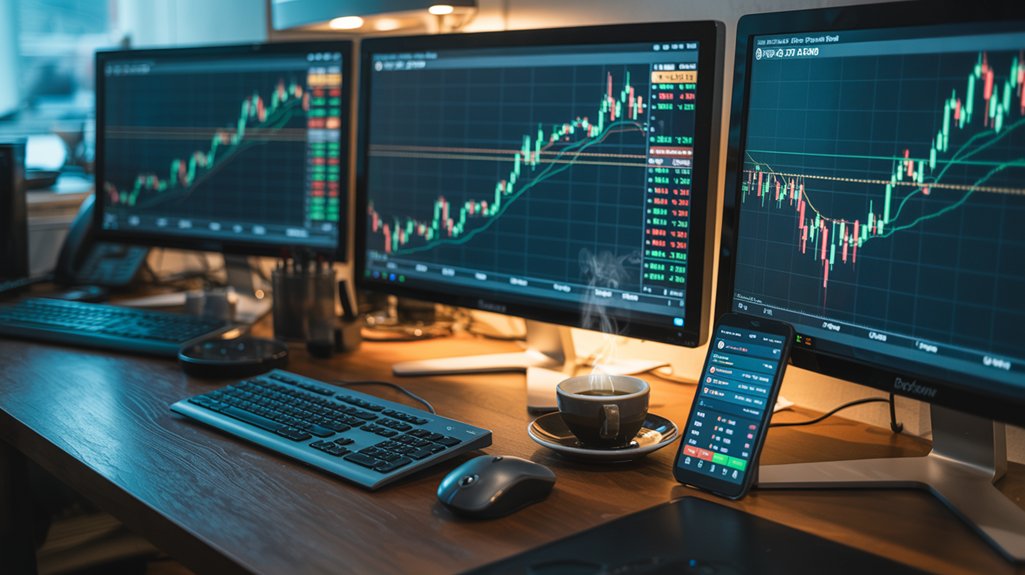
Retail traders now pile into platforms like MT4, MT5, and cTrader without the bureaucratic nightmare that once existed. The process? Stupidly simple. Pick a broker, complete digital onboarding in hours, deposit funds, and start trading. Leverage ratios hit 1:400 to 1:500—which means controlling massive positions with tiny capital. Minimum deposits range from $1 to $500 depending on who you choose. Execution speeds clock in at 0.072 seconds on leading platforms. Spreads start at zero markup on major pairs. Leading platforms integrate educational resources that help traders understand market dynamics and risk management. Traders access 1,000+ instruments spanning forex, indices, commodities, and shares. Understanding trading strategies becomes crucial as traders navigate currency pairs and market volatility. The infrastructure rivals anything in London or New York. No joke.
Best Time to Trade from Zambia
Timing the forex market from Zambia isn't rocket science, but most traders still get it catastrophically wrong.
Zambia operates on CAT (Central Africa Time), which creates four distinct trading windows. The Asian session runs 2:00-6:00 AM—low liquidity, minimal volatility, perfect for swing traders who hate excitement. London opens 10:00 AM-2:00 PM with high liquidity and strong price movements. Scalpers love it. The London-New York overlap hits 2:00-6:00 PM, delivering peak volatility and maximum profit opportunities for short-term traders. New York continues solo from 6:00-9:00 PM with moderate activity. Markets operate 24/5, closing Friday 6:00 PM through Monday 2:00 AM CAT.
Risk-averse traders gravitate toward Asian hours trading AUD/USD and USD/JPY. The aggressive crowd? They're hunting EUR/USD during the overlap. Understanding how different trading sessions affect price action separates profitable traders from those who blame their broker for every loss. Spreads typically widen at rollover, making trading near 6:00 PM CAT impractical for those using tight stop losses.
Payments, Deposits and Withdrawals in Zambia
Moving money in and out of Zambia for forex trading? Good luck with that. The Zambian Kwacha is the only legal tender for domestic transactions, and cash still rules most of the country.
Want to fund a trading account? Visa and Mastercard work at major establishments in Lusaka, Kitwe, and Livingstone. Beyond those cities? Forget it. ATM withdrawals hit you with $5-$10 USD fees per transaction, capped at 2,000-4,000 Kwacha.
Mobile money operators like Airtel Money and MTN Mobile Money are Bank of Zambia-licensed, but require both parties on the same network. US Dollars fly in tourist zones and upscale spots. Everywhere else demands Kwacha. For international transactions, Visa requires customer authentication including name, card number, expiration date, and billing address.
The digital payments market is growing—projected 16.12% CAGR through 2027—but infrastructure remains patchy outside urban centers. Understanding how the Zambian Kwacha performs against major currencies in forex markets helps traders navigate cross-border payment conversions.
Taxes, Reporting and Money Rules in Zambia
How does a country fighting dollar addiction enforce its rules? Bank of Zambia wields administrative penalties under Currency Directives 2025, backed by Sections 18 and 73 of the Bank of Zambia Act, 2022.
Bank of Zambia enforces de-dollarization through administrative penalties, backed by statutory authority under the Bank of Zambia Act, 2022.
Violators pay fines—amounts prescribed by regulators. Corporate bodies face penalties, and here's the kicker: directors and managers share individual liability unless they prove zero knowledge, consent, or connivance in the offense.
The government collects mining tax revenue through Bank of Zambia foreign currency sales, funneling everything through Zambia Revenue Authority.
Domestic transactions require Kwacha settlement except for narrow exemptions—mining taxes, government tolls, diplomatic entities, future foreign currency liabilities.
Exchange rates follow Bank of Zambia's 09:30 mid-rate. These restrictions function as capital controls that regulate how foreign currency flows in and out of the country's financial system.
The regulations emerged from multisectoral stakeholder input through the Public Private Dialogue Forum, culminating in final consultative meetings held in Ndola on 29 August 2025.
Enforcement? Graduated, consultative, unyielding.
Forex Trading Scams and Risks in Zambia
Why would anyone trust a stranger on Facebook promising 500% returns in three weeks? Yet over 50% of forex scams in Zambia now originate from Facebook and Instagram. The math is brutal: only 11-25% of novice traders actually succeed in forex markets, making the rest prime targets for fraudsters.
In 2024, 79% of Zambians faced fraud attempts through email, online channels, phone calls, and text messages. Worse still, 36% actually lost money—median loss hit K6,479 per victim. Between 2023-2024, online and mobile money scams drained over K38 million from Zambian consumers.
The tactics? Guaranteed returns, phishing emails, vishing calls, smishing texts. Social media algorithms help scammers find vulnerable people. Rising living costs make “attractive deals” irresistible. Limited cybersecurity infrastructure means enforcement remains weak. Some traders also face blocked withdrawals when unregulated brokers refuse to release their funds.
Law enforcement has made progress with 117 convictions secured from 560 concluded investigations, though hundreds of cases remain before the courts.
Quick Q and A
Can I Trade Forex in Zambia Using My Mobile Phone?
Yes, retail forex traders in Zambia can trade using mobile phones through international broker platforms like MT4, MT5, or proprietary apps. However, available sources lack specific regulations governing mobile forex trading within Zambia's current legal framework.
What Is the Minimum Amount Needed to Start Forex Trading in Zambia?
The minimum amount ranges from $1 to $300+ depending on the broker. Ultra-low deposit brokers accept $1, mid-range require $5-$10, while standard regulatory brokers typically need $100-$200 to start trading.
Do Zambian Banks Allow Transfers to International Forex Brokers?
Zambian banks do allow transfers to international forex brokers, functioning as the primary transfer method. However, BOZ guidelines mandate all transactions occur through authorized dealers, and international wire transfers often carry significant costs affecting smaller traders.
Which Forex Brokers Accept Zambian Kwacha for Deposits?
Most international forex brokers do not directly accept Zambian Kwacha (ZMW) deposits. Traders typically fund accounts using USD, EUR, or ZAR, with brokers facilitating automatic currency conversion through integrated payment processors during the deposit process.
How Long Does It Take to Withdraw Forex Profits to Zambia?
Withdrawal times for forex profits to Zambia typically range from 1-5 business days, depending on the broker's processing speed and the recipient bank's procedures. International wire transfers may take longer than e-wallet or local bank transfers.
The Bottom Line
Forex trading in Zambia exists in a weird limbo—not exactly illegal, but not properly regulated either. Zambians are trading, mostly through offshore brokers, dealing with payment headaches and tax confusion along the way. The promise of quick dollar gains is tempting in a cash-strapped economy. But the risks are real. Scams lurk everywhere. The infrastructure isn't there. Anyone jumping in needs to understand they're largely on their own, steering through murky waters with little protection.