Forex trading in Lesotho occupies a regulatory gray zone—technically legal but utterly unsupervised. The Central Bank of Lesotho oversees monetary policy and three authorized banks but doesn't license online brokers or enforce investor protections. Retail traders rely on offshore platforms regulated elsewhere—FCA, CySEC, ASIC—while scammers exploit the void with fake credentials and vanishing-deposit schemes. The loti pegs to the rand, exchange controls shape capital flows, and profits face 20–30% marginal tax rates through Revenue Services Lesotho. For anyone curious about market hours, payment rails, or the criminal underbelly, the details below paint the full picture.
Quick Facts That Matter
- Forex trading is legal in Lesotho but operates without dedicated domestic regulation, leaving traders dependent on offshore brokers.
- No local retail brokers exist; Central Bank of Lesotho does not license online forex platforms, creating a regulatory void.
- Scams proliferate through fake platforms and social media, with 32% operating via Facebook, TikTok, and Telegram channels.
- Loti's peg to the South African rand links local currency behavior directly to South African monetary policy decisions.
- Forex profits are taxable income at 20% or 30% rates; traders must report earnings to Revenue Services Lesotho annually.
Overview: Forex Trading in Lesotho
In a landlocked kingdom where mobile phones outnumber bank branches, forex trading has carved out a curious niche among Lesotho's retail investors. The Central Bank of Lesotho oversees banking institutions but there's no dedicated regulator for online retail forex. Three authorized banks handle foreign exchange officially. Everyone else? They're using offshore brokers. No local licensing required. The Central Bank issues warnings about scams, but enforcement remains sketchy.

Retail traders access 24/5 markets through MT4, MT5, and broker apps. Lower capital requirements make entry possible. But education? That's another story entirely. Most traders stumble forward, learning expensive lessons. Understanding trading strategies and risk management principles becomes crucial for navigating the volatile currency markets successfully.
The global forex market's daily trading volume exceeds $7 trillion, offering high liquidity that attracts both novice and experienced Basotho traders to international currency pairs. The Lesotho loti trades at a fixed 1:1 peg to the South African rand, with both currencies circulating as legal tender within the country.
Is Forex Trading Legal in Lesotho?
Forex trading exists in a legal gray zone for Basotho retail traders—technically permitted, practically unregulated.
Lesotho permits forex trading but provides zero regulatory oversight—leaving retail traders in legally acknowledged yet entirely unsupervised territory.
The Central Bank of Lesotho oversees physical currency exchanges through three banks: Standard Lesotho, Nedbank, and First National. That's where official oversight ends.
Online retail forex? Zero local regulation. No licensing requirements for international brokers. Traders access the $7 trillion daily market through offshore platforms—completely legal, totally unmonitored domestically.
It's a peculiar setup: the government acknowledges forex trading‘s legitimacy, yet provides no regulatory framework for the digital side. International standards fill the vacuum. Sort of. Traders operate in recognized-but-unsupervised territory.
This mirrors situations in other African markets where currency exchange trading operates under minimal domestic oversight while remaining technically legal.
Who Regulates Forex Trading in Lesotho?
Nobody's really watching retail forex traders in Lesotho—at least not in the way most countries do it.
The Central Bank of Lesotho oversees monetary policy and supervises three authorized banks: Standard Lesotho Bank, Nedbank, and First National Bank.
But online brokers? Not their problem. CBL doesn't license retail forex platforms.
Revenue Services Lesotho cares about your profits—20% or 30% tax brackets apply—but there's no dedicated watchdog for the retail trading game.
It's an open field. Which sounds great until something goes wrong and nobody's home to answer the phone. Most established international brokers are regulated by top-tier authorities like the FCA, CySEC, or ASIC—protections that matter when things get messy.
Without clear legal frameworks in place, traders operate in a regulatory gray zone where enforcement and investor protection remain largely undefined.
How Forex Trading Works in Lesotho
Trading forex in Lesotho means logging into a platform—usually MetaTrader 4, MetaTrader 5, or some broker's proprietary app—and speculating on currency pairs.
Forex trading here boils down to screens, offshore brokers, and currency speculation—nothing fancy, mostly functional.
No domestic broker exists, so traders pick offshore outfits. Regulated names like JustMarkets promise compliance with international standards, transparency, ethical practices.
The loti pairs—LSL/ZAR, LSL/USD—exist in theory but hardly show up on retail platforms. Most Basotho traders stick to ZAR pairs or major crosses.
Leverage amplifies bets.
Profits get taxed at 20% or 30%, depending on bracket.
Enforcement? Sketchy.
Converting funds at market rates faces zero restrictions.
Copy trading, PAMM accounts, mobile apps—all standard retail fare.
These forex trading platforms provide the infrastructure for buying and selling currencies in the foreign exchange market, complete with charts, execution tools, and real-time pricing.
Best Time to Trade from Lesotho
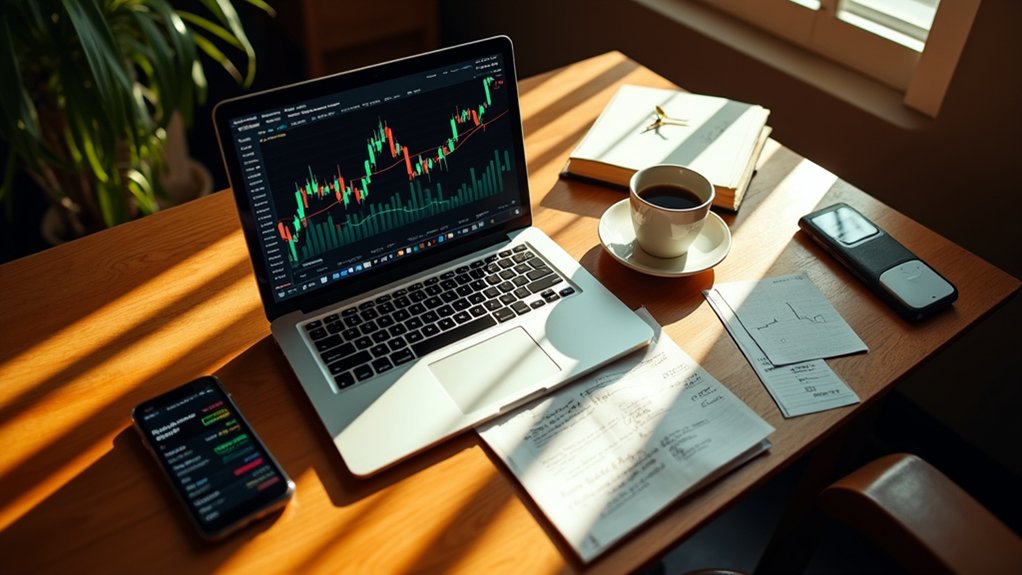
From a Maseru apartment at three in the afternoon, a trader watching EUR/USD catches the exact moment London bankers return from lunch and New York desks flip on their terminals.
That overlap—3:00 to 7:00 pm SAST—delivers the tightest spreads and wildest swings.
Mondays? Slow. Fridays fade fast. Tuesday through Thursday is where the action lives.
Most Basotho traders sleep through Tokyo's open at 11:00 pm. Fair enough.
The real money moves when two continents collide.
NZD/JPY at midnight works for insomniacs.
Everyone else waits until London wakes up and New York joins the fray. Major pairs like EUR/USD and GBP/USD offer the most stability for those just starting out.
Understanding market activity patterns helps traders identify which sessions suit their chosen currency pairs best.
Calm and slow markets can drain hours without a single trade worth taking.
Payments, Deposits and Withdrawals in Lesotho
Timing the London-New York window means nothing if a trader can't move money in or out of an account.
Lesotho runs on cash for most transactions. Debit cards work. Credit cards exist but aren't everywhere. M-PESA and EcoCash handle mobile money. Apple Pay, Google Pay, and PayPal operate here. Banks like Standard, Nedbank, FNB, and Investec connect to SWIFT for international transfers. MoneyGram and Western Union move funds cross-border. Regulatory hurdles include Balance of Payment forms.
Rural areas? Forget it—digital infrastructure is skeletal. Maseru has options. Elsewhere, good luck finding fintech coverage. Visa and Mastercard remain the most widely accepted international card networks for forex deposits and withdrawals. Traders should research withdrawal methods carefully to minimize fees and protect against fraud when transferring earnings from forex accounts to local banks.
Taxes, Reporting and Money Rules in Lesotho
When profits land in a trader's account, Revenue Services Lesotho wants its share. Forex gains count as taxable income—20% or 30% marginal rates apply, depending on total earnings. Traders must report everything on annual returns.
Sounds straightforward. Reality? The regulatory framework remains underdeveloped, enforcement proves challenging, and the Central Bank of Lesotho doesn't even license online brokers. CBL has issued scam warnings, though.
Short-term trading gets taxed differently than long-term positions. The loti pegs to the rand, exchange controls exist, and RSL oversees collection. Like Nigeria's approach to currency exchange rates, central bank interventions can significantly influence forex market dynamics and trader outcomes. Tax pros become essential when steering Lesotho's evolving—and occasionally confusing—forex tax landscape.
Forex Trading Scams and Risks in Lesotho
Lesotho's forex market operates in a regulatory void, and scammers absolutely love it. No dedicated oversight body exists. The Central Bank of Lesotho doesn't license online brokers, so fake platforms proliferate freely. Fraudsters set up polished websites, forge regulatory credentials, accept deposits—then vanish when withdrawal requests arrive.
Signal sellers promise guaranteed profits through “insider algorithms” while collecting subscription fees for worthless advice. Social media amplifies the damage: roughly 32% of forex scams now operate through Facebook, TikTok, and Telegram.
And here's the kicker—forex trading doubles as a money laundering platform. The absence of leverage restrictions just sweetens the deal for criminals.
Quick Q and A
Can I Trade Forex Part-Time While Keeping My Regular Job in Lesotho?
Yes, part-time forex trading is feasible in Lesotho alongside regular employment. The 24/5 market structure, mobile trading platforms, and evening session availability during London-New York overlaps enable traders to participate outside standard working hours with manageable capital requirements.
What Internet Speed Do I Need for Forex Trading in Lesotho?
Most forex traders in Lesotho require 2-5 Mbps download speed for basic order execution. Vodacom's 42.5 Mbps and Econet's 17.95 Mbps exceed minimum thresholds. Mobile 3G/4G networks adequately support trading apps across 92.5% broadband coverage areas.
Do Lesotho Brokers Offer Demo Accounts Before Trading Real Money?
Most forex brokers accepting Lesotho traders provide demo account (Official Site 🔗) options through MT4 and MT5 platforms. These risk-free practice accounts typically last 30 days, enabling traders to test strategies and evaluate broker execution quality before depositing real funds.
Can I Copy Trades From Experienced Traders Using Social Trading Platforms?
Yes, traders can copy experienced performers through global social trading platforms like ZuluTrade, eToro, and AvaTrade (Official Site 🔗). These services offer automated strategy replication, performance tracking, and demo testing, enabling Lesotho traders to mirror successful approaches despite local regulatory limitations.
What Happens to My Forex Account if My Broker Goes Bankrupt?
Client funds held in segregated accounts transfer to another broker through a bankruptcy trustee. However, poor record-keeping or fraud may limit recovery. Lesotho traders should verify their broker maintains proper fund segregation and regulatory compliance.
The Bottom Line
Forex trading in Lesotho exists in a regulatory void. No local oversight, no clear tax rules, no domestic brokers. Traders use offshore platforms, deal with spotty internet, and hope their withdrawals actually arrive. The loti-rand peg simplifies some currency decisions but complicates others. It works—sort of—because international brokers accept Basotho clients and mobile money bridges the banking gaps. Legal? Technically. Safe? That's another question entirely. Welcome to frontier market trading.