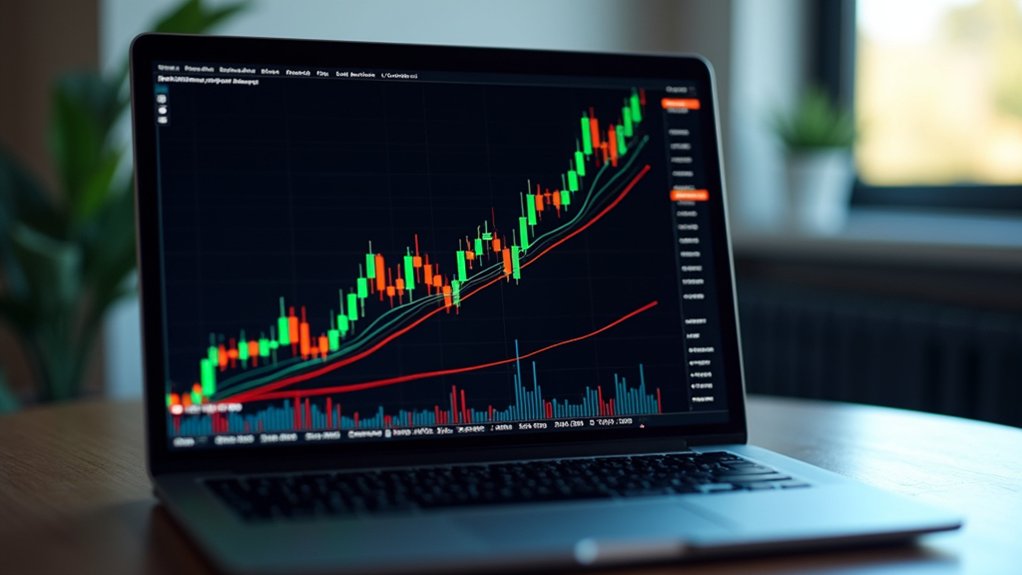

A solid forex trade setup starts with confirming trend direction on a longer time frame like the four-hour or daily chart. Traders then hunt for recognizable price patterns—head and shoulders, double tops, triangles—near support or resistance zones. Tossing in a technical indicator such as RSI or a ten-period exponential moving average adds extra confirmation before pulling the trigger. Stop losses sit at recent swing highs or lows, while profit targets follow risk-reward ratios of 1.5:1 or higher. The mechanics behind these choices reveal why pattern recognition matters.

In the thick of volatile currency swings and patchy internet connections, African forex traders hunt for one thing above all else: a setup that actually works. From Lagos to Nairobi, from Cairo to Cape Town, the search plays out the same way. Traders stare at charts, looking for patterns that might—just might—signal a decent entry point.

Patterns matter because they capture market psychology in visual form. Head and shoulders, double tops, triangles, flags. These formations show up whether someone in Accra is trading USD/ZAR or a trader in Dar es Salaam is watching GBP/NGN. Breakouts, continuations, ranges, reversals—all these setups rely on price bar arrangements that repeat over time. Distribution and accumulation patterns hint at possible reversals. Historical price performance gives context. Without it, a pattern is just a guess.
Patterns capture market psychology in visual form—breakouts, reversals, and continuations that repeat across time, giving historical context to every trade setup.
Trends separate the serious from the wishful. Higher highs and higher lows confirm an uptrend. Lower highs and lower lows mark a downtrend. Simple stuff, really. But many African traders skip this step, jumping straight into trades without checking the broader direction. Big mistake. Clustering price action at support or resistance often signals a shift. Longer time frames—four-hour, daily—offer clearer trend data than the one-minute chaos that tempts impatient traders in Kampala or Lusaka. Spotting market trends reduces analysis time and lets traders focus resources on the most likely price movements.
Technical indicators add another layer. Moving averages, particularly the ten-period exponential, help spot the underlying trend and potential retracement zones. RSI flags overbought or oversold conditions. Bollinger Bands measure volatility and hint at turning points. Traders in Johannesburg and Casablanca combine these tools for confirmation. An engulfing candle near the EMA? That's a trigger many watch for. The simple moving average calculates by adding closing prices over a set period and dividing by the number of periods, making it easier to smooth out price fluctuations. Some traders rely exclusively on historical price movements to make trading decisions, avoiding indicators altogether in favor of pure chart reading. Raw price movements on charts often reveal market sentiment more directly than lagging indicators can capture.
A good setup demands clear criteria. Entry hinges on a visible pattern or indicator signal. Stop loss gets placed at a logical level—usually a recent swing high or low. Profit targets follow risk-reward ratios, often one-and-a-half or two to one. The trade must align with the broader trend. Those ratios matter more over time than any single win. Trailing stops help lock in gains while letting trends run. Weekend planning helps traders map future goals and prepare trade plans before the Monday open.
Time frames shape everything. Shorter intervals pump out signals but also noise. Longer charts reveal high-probability setups, though patience becomes the price of admission. Traders in Harare or Kigali who stick to one time frame improve their pattern recognition. Consistency beats jumping around. Building a reliable trading approach requires committing to specific parameters and refining them through experience.
Trade review closes the loop. Documenting setups and outcomes builds skill. Analyzing past mistakes prevents repeat disasters. African traders face enough obstacles—regulatory uncertainty, limited broker options, currency restrictions. At least the chart doesn't care where you live.
Common Questions
Which African Brokers Offer the Best Spreads for South African Rand Pairs?
Exness leads with ultra-low spreads and instant execution on ZAR pairs, holding FSCA license 51024.
BlackBull Markets runs ECN accounts starting at 0.0 pips for major and ZAR crosses.
Fusion Markets consistently delivers tight averages with low commissions.
Pepperstone and FXPro round out the top five with competitive pricing and solid liquidity.
All operate under South Africa's FSCA, offering local bank transfers and ZAR base accounts.
MT4 and MT5 come standard across the board.
How Do Power Outages in Nigeria Affect My Open Trade Positions?
Power outages leave Nigerian traders completely blind to their open positions. No access means no ability to adjust stop losses, take profits, or close trades manually during market swings.
With some areas experiencing outages 84.8% of days and grid collapses happening 220+ times in a decade, positions sit exposed to volatility with zero control. Restoration averages 5-6 hours now.
Equipment failure causes 32% of outages—totally unpredictable. Backup power helps, but it's not foolproof for everyone.
Can I Trade Forex Legally in Countries Like Ethiopia or Algeria?
Ethiopia's National Bank only licenses authorized forex bureaus and banks—online retail forex platforms aren't permitted. The July 2024 reforms freed banks to set exchange rates, but didn't legalize individual online trading.
Algeria's even stricter: all forex must flow through licensed banks or authorized intermediaries.
Traders caught using unlicensed platforms face fines up to $2,500 in Ethiopia. Algeria prosecutes violations under exchange control laws. Both countries maintain tight capital controls despite recent liberalization talk.
What Deposit Methods Work Best for Traders in Ghana or Kenya?
Mobile money dominates in both countries. M-Pesa rules Kenya, while MTN Mobile Money leads in Ghana. They're fast, instant often, and everyone uses them.
Most traders prefer these over bank transfers, which crawl along for days. Credit cards work fine for deposits, and Skrill or Neteller handle international moves smoothly.
The catch? Not every broker accepts mobile money, transaction limits can frustrate larger traders, and currency conversion fees bite hard when changing GHS or KES to USD.
How Does Currency Devaluation in Zimbabwe Impact My Trading Account Balance?
Currency devaluation in Zimbabwe hammers trading account balances hard. If the account is denominated in Zimbabwean dollars, value evaporates—sometimes overnight.
The ZWL fell 70% in early 2024 alone. Black market rates diverge wildly from official ones, making real account value anyone's guess.
Withdrawals buy less each day. Most Zimbabwean traders now denominate balances in USD or other stable currencies to survive. Holding ZWL during devaluation spikes? That's watching capital vanish in real time.