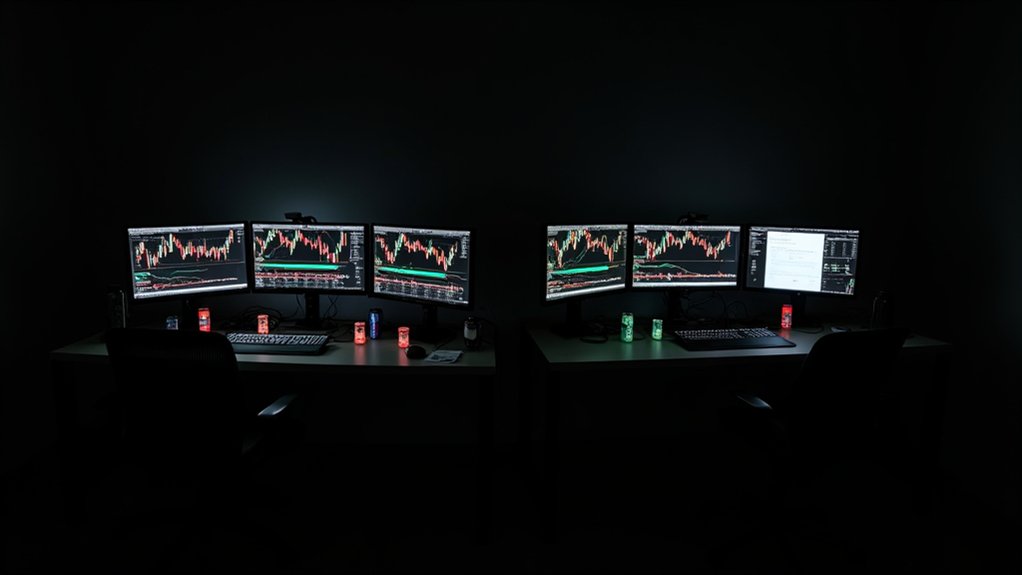
Demo accounts let traders practice without blowing up their bank accounts, which matters because most beginners lose money fast when real cash hits the table. The simulation removes financial risk while building familiarity with platforms, order types, and market behavior. Psychology develops gradually without panic-induced bad decisions. Strategies get tested against live data, weak approaches get eliminated, and muscle memory forms through repetition. It's fundamentally survival training before deployment—mistakes happen in a consequence-free zone where lesson-learning doesn't require bankruptcy. The mechanics below show exactly how this preparation translates into better live performance.

Before risking a single shilling, naira, or rand on live Forex trades, African traders should understand one simple truth: demo accounts exist for a reason, and that reason isn't just marketing fluff from brokers.

Simulated trading removes financial risk entirely. Mistakes happen without real monetary loss. New strategies get tested without bleeding capital. The statistics tell a harsh story: 87% of beginners face early trading difficulties. That demo account (Official Site 🔗) phase? It's not optional for most people. It's survival preparation. Hands-on learning beats theory every time, especially when understanding how things actually work in practice. Trading psychology gets introduced gradually, without the stomach-churning stress of watching real money disappear.
Demo accounts aren't broker marketing gimmicks—they're survival preparation before real capital enters unforgiving markets.
Confidence doesn't appear overnight. Demo accounts build it through repetition and familiarity. The intimidation factor of live markets drops when traders already know the mechanics. Mistakes in simulation lead to learning. Mistakes with real cash lead to panic and poor decisions. Objective trade review becomes possible when emotions aren't running wild over losses. Repeated exposure to market scenarios improves composure long before actual capital enters the equation. Keeping a trading journal during the demo phase helps traders record their reasoning and outcomes for later review.
Platform familiarity matters more than most traders realize. Order types, charting tools, analytics features—they vary between brokers operating across Kenya, Nigeria, South Africa, Ghana, and elsewhere. Interactive experience with technical indicators happens in real time without consequences. Errors from unfamiliarity with platform functions get eliminated before real money is involved. Trade execution, position sizing, navigation—all these operational details need practice. Customization and settings can be tested for optimal efficiency without risk.
Strategy development requires testing. Demo environments allow evaluation and backtesting using live market data without risking funds. Strategy outcomes get analyzed under different volatility and liquidity conditions common in African trading hours. Entry and exit rules get refined based on performance feedback. Multiple approaches, from scalping to swing trading, can be compared safely. Weak strategies get identified and eliminated before real money deployment. Traders can develop proprietary strategies in a low-pressure environment where financial stress doesn't interfere with objective evaluation.
Understanding market dynamics comes through simulation of actual conditions, including price movements and spreads. Experience with both trending and ranging markets aids pattern recognition. Real-time data supports practice adapting to news events and economic releases affecting currencies like the South African rand, Nigerian naira, or Kenyan shilling. Currency correlations and cross-pair behaviors become clearer through observation. Demo accounts provide access to various currency pairs that mirror what's available in live trading environments. Once comfortable with demo trading, understanding minimum capital requirements helps traders make informed decisions about when they're financially ready to transition to live accounts.
Performance tracking in demo environments enables journal tracking of trades, wins, losses, and consistency. Regular review identifies behavioral patterns and areas for improvement. Advanced charting tools and analytics monitor personal growth. Realistic goal-setting and achievement measurement happen before proceeding to live accounts. Objective performance metrics reveal whether someone is actually ready for live market participation. Systematic record-keeping during the demo phase establishes disciplined habits that carry over into live trading. Many brokers also offer tutorials and webinars alongside demo accounts to accelerate the learning process. Following structured instructions during the demo phase helps traders establish a systematic approach to entering the market. Accessing beginner-friendly resources during this learning period provides the foundational knowledge needed before transitioning to live markets.
Nearly all brokers serving African markets offer free demo account access. No cost, no commitment, just practice.
Common Questions
Can I Switch From Demo to Live Trading With the Same Broker in Africa?
Yes, most brokers operating in Africa allow traders to switch from demo to live accounts. It's not really a “switch” though—traders open a separate live account with the same broker.
Different login credentials. Different server. The demo account doesn't magically convert. Brokers like those regulated by South Africa's FSCA require KYC verification before activating live accounts.
Minimum deposits apply. The process involves registering for a live account through the broker's platform, verifying identity, and funding the account before trading real money.
Do Demo Accounts Show Real Spreads Charged to African Traders?
Most brokers claim demo spreads mirror live conditions—and for major pairs, they often do.
But here's the catch: demos skip the messy stuff. No slippage during volatility. No requotes. No liquidity gaps that widen spreads when markets actually move.
African traders using ZAR or exotic crosses? Even less accurate.
HFM and FXCM promise tight demo spreads matching live accounts, but real execution under pressure tells a different story.
Demos show ideal conditions, not battlefield reality.
How Long Should African Traders Practice on Demo Before Going Live?
African traders should demo trade for 4 to 6 months minimum before risking real money. That's the standard recommendation—not a few weeks, not one month.
The goal? Hit around 2% monthly profit consistently, keep drawdowns under 6%, and maintain a profit factor above 1.75. Consistency matters more than lucky streaks.
Most rush in too early and pay for it. The stats are brutal: 90% of retail forex traders lose money.
Demo time isn't wasted—it's survival prep.
Are Demo Account Features Identical to Live Accounts for Nigerian Traders?
Demo accounts for Nigerian traders closely mirror live platforms—same charts, indicators, and MetaTrader access. But they're not identical.
Virtual money removes psychological pressure entirely. Execution often looks cleaner on demo; slippage and requotes hit harder when trading live.
Bonuses, funded account programs, and premium tools? Those stay locked behind live accounts. Most demos default to USD, not Naira. Plus, broker support responds faster when real money's on the line.
Close, but not the same experience.
Will My Demo Trading Results Predict My Live Trading Performance in Kenya?
Demo results won't reliably predict live performance in Kenya. Traders typically see about a 20% performance drop when switching to real money.
Why? Demo accounts skip the brutal stuff—slippage, wider spreads, trade rejections, psychological meltdowns. Demo trading removes fear and greed from the equation, which is like practicing surgery on a mannequin.
Real market conditions hit different. Spreads widen, orders don't fill at dream prices, and suddenly that winning strategy from demo mode starts bleeding actual shillings.