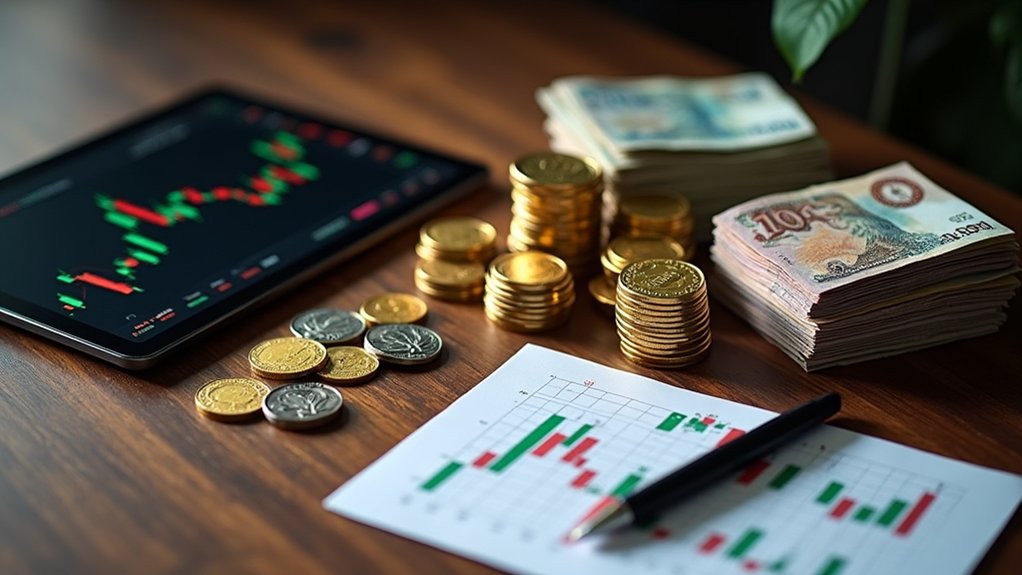
Compounding in forex means reinvesting profits back into the trading account instead of withdrawing them. Returns get earned on the original capital plus all accumulated gains. It's exponential growth, not linear. A $1,000 account earning 5% monthly hits roughly $1,796 after twelve months with compounding versus just $1,600 with simple interest. The math works, but only if traders have the discipline to leave profits untouched and manage risk properly as position sizes grow. The fundamentals reveal why patience matters more than most expect.

Compounding in Forex Trading
Compounding in forex means taking the money earned from trades and plowing it right back into the account to grow the trading capital—and then watching what happens next. It's basically the old compound interest idea but dressed up in trading clothes. Instead of earning returns only on the original deposit, traders earn returns on their original capital plus whatever they've already made. That's where things get interesting for traders from Nairobi to Lagos to Johannesburg trying to build wealth through forex.

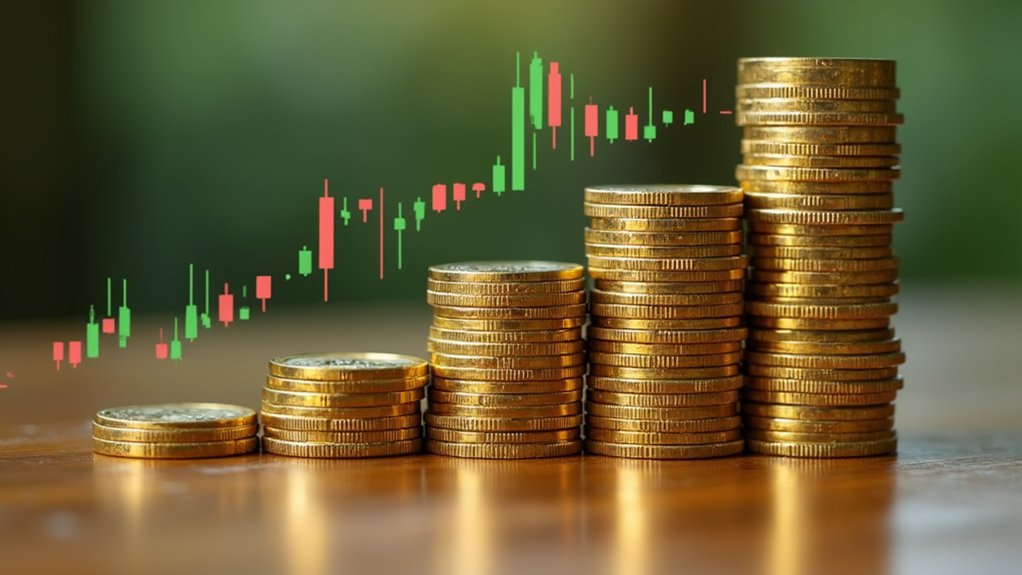
Compounding turns trading profits into fuel for growth—earning returns not just on your deposit but on everything you've already made.
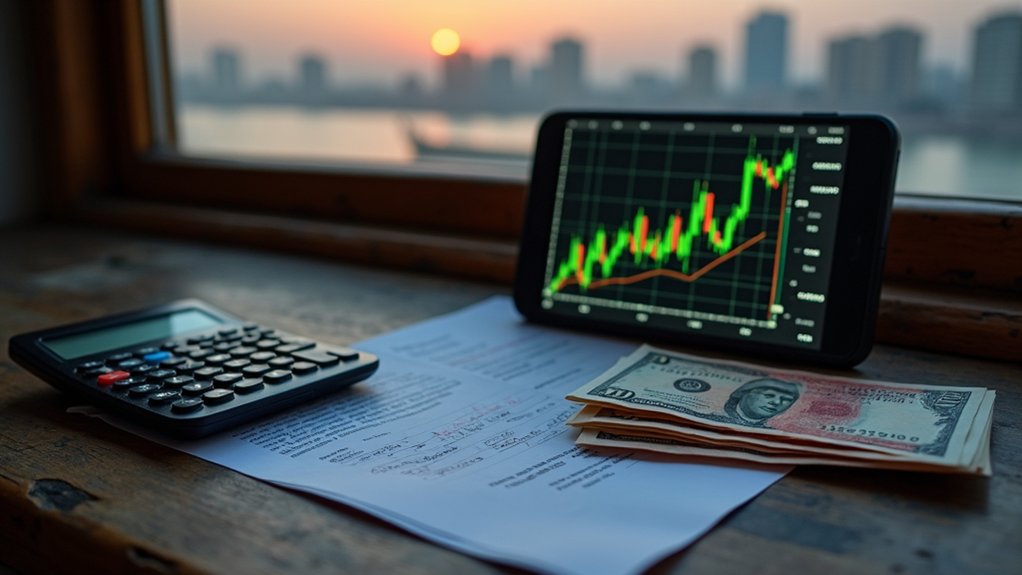
The math behind it isn't rocket science. The formula looks like this: E = P × (1 + r)^n. E is the ending balance, P is the starting capital, r is the return per period as a decimal, and n is the number of periods. Say a trader in Accra starts with $1,000 and makes 5% monthly. After twelve months of compounding, that account hits roughly $1,795.86. With simple interest—where gains come only from the initial deposit—it would reach just $1,600. The difference? Compounding earns interest on interest. The gap widens dramatically over time.
This is what separates compounding from simple interest. Simple interest produces linear growth, a straight line on a chart. Compound interest produces exponential growth, a curve that bends upward. A trader in Kigali making $50 per month on $1,000 with simple interest always makes $50. But with compounding, that $50 becomes $52.50 the next month, then $55.13, and it keeps climbing because the account balance keeps growing.
For African traders dealing with dollar-denominated accounts while earning income in naira, shillings, or rand, compounding offers a path to scale up small accounts over time. But it demands discipline. Profits must stay in the account instead of being withdrawn. Risk per trade should be fixed as a percentage so position sizes grow systematically as the account grows. A Kenyan trader risking 2% per trade will see that dollar amount increase as compounding does its work. Calculating appropriate trade sizes based on account balance and stop-loss levels helps ensure that position sizing stays proportional as capital grows. Longer time horizons amplify the compounding effect significantly. Implementing capital preservation strategies protects the growing account from catastrophic losses that would undo months of compounded gains.
The catch? Risk compounds too. As position sizes grow, so do potential losses. A string of losing trades can shred an account faster when it's been built up through compounding. Drawdowns hit harder. A trader in Dar es Salaam who's grown an account from $500 to $2,000 through compounding now has more to lose. Successful compounding requires traders to evaluate account size, risk tolerance, and market conditions before determining how much capital to allocate per trade. Understanding realistic monthly earnings helps traders set achievable compounding targets that align with what professional forex traders actually make. The strategy works best with consistent execution, solid risk management, and a long time horizon. Compounding isn't magic—it's math applied patiently. Swing trading can work alongside compounding when profits from medium-term positions are periodically reinvested.
Common Questions
Can I Compound Profits With Unstable Currencies Like the Zimbabwean Dollar?
Compounding profits with the Zimbabwean Dollar is practically impossible. The currency has collapsed spectacularly—hyperinflation hit 79.6 billion percent in 2008, wiping out any gains. Three redenominations between 2006–2009 erased zeros constantly. The ZWD lost so much value that by 2009, bills reached Z$100 trillion. Zimbabwe ditched its own currency entirely that year.
Even newer currencies like the ZiG face brutal instability, hitting all-time lows regularly. Compounding requires stability. Zimbabwe offers chaos.
Do Nigerian Brokers Allow Automatic Compounding or Must I Manually Reinvest?
Nigerian brokers don't hand traders automatic compounding on a silver platter. MT4, MT5, and cTrader—the usual suspects—add profits to balances, but sizing the next trade? That's manual. Unless the trader fires up an EA or jumps into copy trading with FP Markets, FXTM, RoboForex, or HFM.
PAMM and MAM accounts compound automatically, manager does the work. Otherwise, it's spreadsheets and discipline. Brokers don't block automation tools; they just don't do the compounding for anyone.
How Does Compounding Work When Withdrawing Money for Living Expenses in Kenya?
Kenyan traders face a tough trade-off. Every shilling withdrawn for rent or food cuts the principal, killing the compounding effect.
Monthly profits compound on what's *left*, not the original balance. Most use hybrid tactics—withdrawing a fixed percentage of profits, keeping some capital growing.
It slows growth but keeps bills paid. Currency swings between USD and Kenyan shilling add extra headaches.
Plus, Kenyan banks sometimes delay Forex withdrawals, messing up cash flow planning.
What Minimum Account Size Do South African Brokers Require for Effective Compounding?
Most South African brokers let traders open accounts with R0 to R500 ($0–$25)—basically nothing. Trade Nation requires zero. IFX wants R182. Exness takes $1.
But here's the reality: opening cheap and compounding effectively are different beasts. Traders typically need at least $100–$200 (R1,800–R3,600) to actually compound without spreads and commissions eating returns alive. Micro-lot trading helps, but dust accounts struggle. Bigger balances survive the grind better.
Does Compounding Still Work During Frequent Power Outages Affecting African Traders?
Compounding struggles badly during frequent outages across Africa. The strategy demands unbroken sequences of reinvestment—hard to pull off when the grid dies mid-trade in Lagos or Nairobi.
Traders lose access, can't execute, and watch positions turn toxic without monitoring. VPS hosting helps, but many don't have it. Mobile data fails when towers lose backup power.
Sure, compounding *works* in theory, but power cuts wreck the consistency it needs. Reality bites hard here.