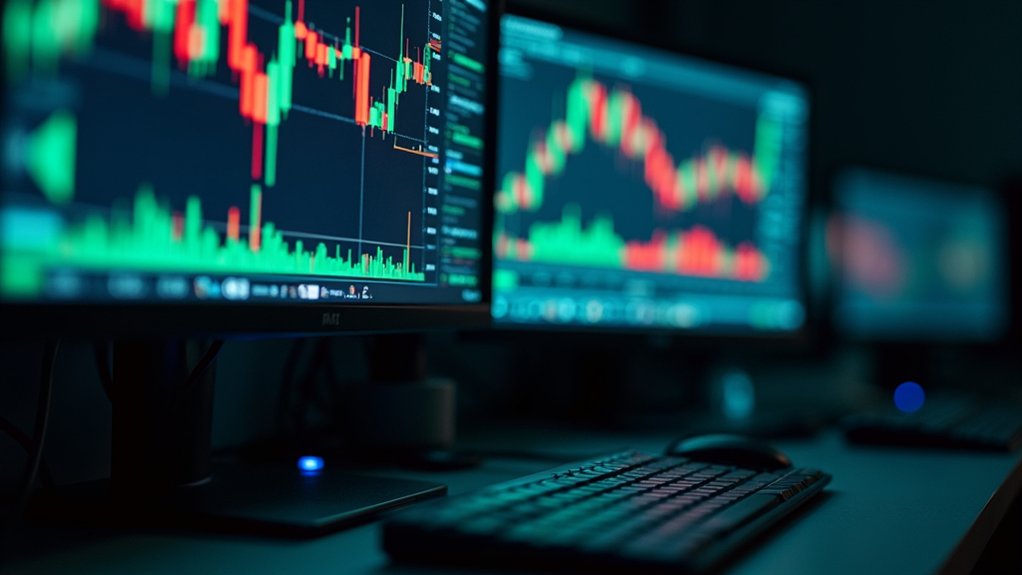
In the span of just a few years, fintech has stormed the Forex market like a digital tsunami—and it's not slowing down. Algorithmic trading now commands over 90% of Forex volume in 2025. That's not a typo. Automation has basically taken over, with both retail traders and institutional giants deploying bots like there's no tomorrow. MetaTrader platforms are crawling with automated systems, and high-frequency trading latency has dropped to 100–300 milliseconds. The fastest systems? Sub-100 ms. Blink and you've missed the trade.
Algorithmic trading owns over 90% of Forex volume in 2025—automation has conquered the market at lightning speed.
AI tools are powering roughly 15% of Forex trades this year, but machine learning is influencing over half of institutional trading decisions. These aren't your grandfather's trading strategies. Predictive analytics crunches years of historical data for near real-time market forecasting. Sentiment analysis scans financial news and social media to gauge market mood shifts. AI-driven risk management systems detect anomalies and learn from real-time data, cutting the odds of catastrophic losses. Adaptive algorithms now tweak strategies automatically when markets go sideways.

Blockchain has crashed the party too. One-third of Forex brokers are using it to boost transaction transparency and security. Crypto-Forex hybrids are gaining serious traction, with crypto assets getting folded into traditional FX frameworks—though regulators are tightening the screws with stricter KYC and marketing rules. DeFi-powered Forex platforms on decentralized exchanges offer blockchain alternatives to conventional trading. Settlement risk? Reduced, especially for cross-border trades.
Mobile platforms dominate retail access now, letting traders execute in real-time from anywhere. MetaTrader 5 has overtaken MT4 with a 54.2% market share of combined volume. Custom platform development is surging, embedding compliance and risk controls at the infrastructure level. Microservices architecture speeds updates with minimal downtime. FIX API protocol enables direct automated connections between traders and liquidity providers, delivering the high-speed execution that modern algorithmic strategies demand. Big Data enables pattern recognition across currencies, commodities, and macroeconomic indicators. High-frequency forex trading leverages sophisticated algorithms to capitalize on minute price discrepancies across currency pairs, executing massive trade volumes in fractions of a second. Modern brokers increasingly offer ECN execution models that connect traders directly to liquidity providers for tighter spreads and faster order processing.