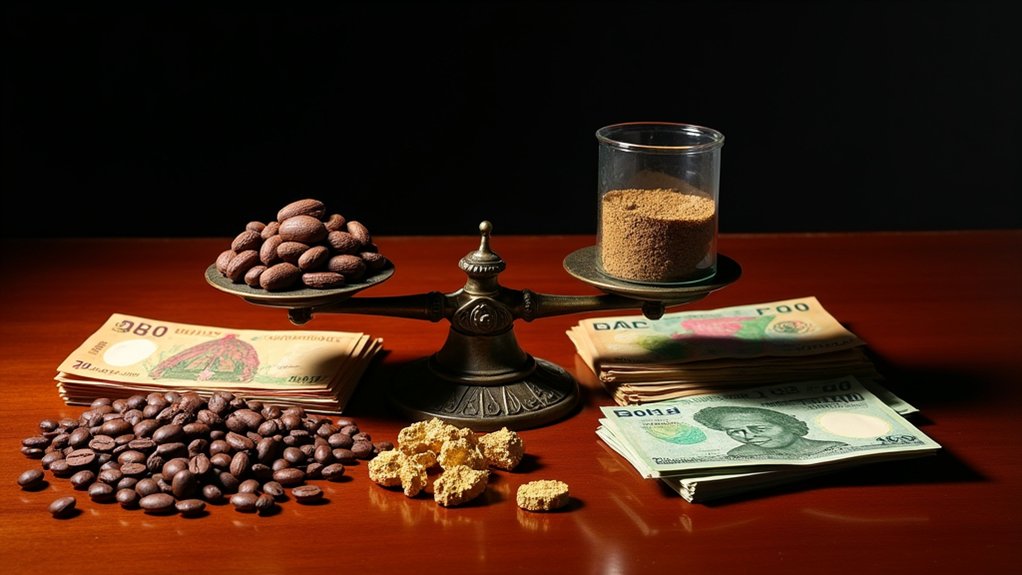

Balance of trade in forex is exports minus imports—plain math that moves currencies fast. When a country sells more abroad than it buys, it posts a surplus and its currency usually strengthens. Run a deficit and the currency often weakens because more money flows out than in. Traders in Johannesburg and Lagos watch these monthly numbers like hawks because they create instant volatility. Commodity exporters like Nigeria, Ghana, and Zambia see wild swings when oil or cocoa prices shift. The patterns reveal whether an economy competes globally or just burns through imports—and the implications stretch far beyond headline figures.
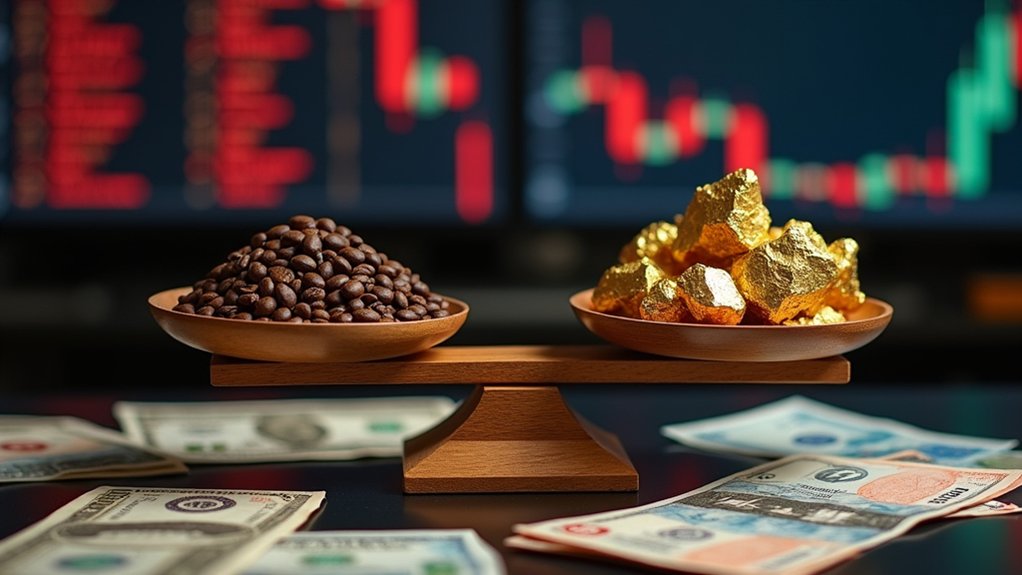
The trade balance—that monthly scorecard showing whether a country sold more than it bought or spent more than it earned—matters more to African Forex traders than most realize. It's the difference between the value of a nation's exports and imports over a specific period. Simple math: exports minus imports. Positive number? Trade surplus. Negative? Trade deficit. This figure doesn't just sit in government reports gathering dust—it moves currencies, sometimes violently.

Trade balance data moves African currencies fast—exports minus imports creates volatility traders can't afford to ignore.
In Nigeria, Kenya, South Africa, and Egypt, where Forex trading communities are growing fast, balance of trade data drops like a monthly bomb. Traders watch these numbers because they signal currency strength or weakness before the market fully digests what happened. A strong surplus can lift a currency; a deficit can drag it down. Supply and demand for naira, shilling, rand, or pound shift based on whether the country is earning hard currency from exports or bleeding it through imports. The Nigerian Naira, like other emerging market currencies, experiences volatility tied directly to shifts in trade balance figures.
The formula is dead simple: value of exports minus value of imports. But the implications? Complex. Ghana exports gold and cocoa. Zambia ships copper. Angola sells oil. When global commodity prices surge, their trade balances improve, and their currencies can strengthen—assuming other factors cooperate, which they rarely do. When prices crash, deficits widen, and the Forex market punishes the currency. African traders know this cycle intimately because commodity dependence defines many economies across the continent. The Ghanaian Cedi responds particularly sharply to cocoa and gold price movements, making it a commodity-sensitive currency in the Forex market.
Trade balance is a key slice of the current account, that broader measure of money flowing in and out. Some countries report goods and services separately; others lump them together. Doesn't matter much to the trader scanning for the headline number before the market opens in Johannesburg or Lagos.
Persistent surpluses can indicate competitive export sectors and national strength. Persistent deficits? They suggest overreliance on imports, potential borrowing needs, and structural weakness. Morocco, Tunisia, and Egypt often run deficits. Botswana and Namibia sometimes post surpluses thanks to diamonds and minerals. These patterns shape long-term currency trends, not just daily volatility. Increased government spending often drives deficits wider, especially when federal budget deficits expand simultaneously.
Exchange rates, trade policies, global cycles, and geopolitical shocks all influence the trade balance. A currency devaluation in Zimbabwe or a tariff change in Tanzania alters import costs and export competitiveness overnight. The balance of trade equals the difference between a country's output and domestic demand for goods—a gap that widens when local consumption outstrips production or narrows when factories run hot and exports climb. Countries sometimes deploy foreign exchange reserves to manage temporary imbalances when export earnings fall short of import bills. Beyond trade alone, political stability shapes investor confidence and capital flows that ultimately affect currency valuations alongside trade figures. Forex traders across Africa use trade balance reports to gauge economic health and forecast where currencies might head next. Economic data releases containing trade figures create immediate market reactions as traders assess whether actual numbers beat or miss consensus forecasts. It's not foolproof—nothing is—but ignoring the trade balance is ignoring reality. And in African Forex markets, reality has sharp teeth.
Common Questions
How Does Nigeria's Oil Export Balance Affect the Naira's Strength?
Nigeria's oil exports are the main forex tap. When crude sales dropped N3.18 trillion in H1 2025—down 11.3% year-on-year—it choked dollar inflows and squeezed the naira. Oil's share of exports crashed from 71% to 53% in a year.
Less oil revenue means fewer dollars for the Central Bank to defend the currency. Trade surplus hit N12.64 trillion, but that's only because non-oil exports doubled and imports fell. Oil still rules naira strength.
Can Kenyan Traders Profit From Uganda's Trade Deficit With China?
Kenyan traders can theoretically profit by speculating that Uganda's massive import bill from China—$1.38 billion in 2024—will weaken the Ugandan Shilling against major currencies.
The catch? Direct UGX/CNY pairs have laughable liquidity. Most brokers don't even offer them.
Traders would need to play USD/UGX instead, betting on shilling depreciation as Uganda burns through forex reserves buying Chinese machinery and electronics.
Regional central bank interventions can kill the trade fast, though.
Profits exist, but execution is messy.
Why Do South African Brokers Restrict Trading During Trade Data Releases?
South African brokers halt trading during major trade data releases because FSCA regulations demand it.
Volatility spikes, spreads blow out, liquidity vanishes. Risk management, plain and simple. Brokers don't want slippage complaints or execution disasters on their hands.
The regulator wants segregated accounts protected, transparent disclosures made, and systemic risks controlled. So when the numbers drop, trading stops.
It's not some conspiracy—it's compliance mixed with self-preservation. Volatile markets equal unpredictable pricing, and nobody wants that mess.
Does Egypt's Suez Canal Revenue Impact Its Trade Balance Calculations?
Yes, absolutely. Egypt counts Suez Canal revenue as service exports in its current account—meaning every dollar from ship tolls flows straight into trade balance calculations.
The canal pulled in $61 billion over a decade to 2023, hitting a record $9.4 billion in fiscal 2022-2023.
But when Red Sea chaos slashed transits in 2024, Egypt lost $6 billion in canal income, hammering the trade balance and forcing tighter import controls.
It's a massive lever.
How Do Ghanaian Cocoa Exports Influence Cedi Volatility in Forex?
Ghanaian cocoa exports pump dollars into the economy, directly strengthening the cedi when harvests boom.
First half of 2025 saw cocoa earnings nearly triple to $2.17 billion—that flood of foreign currency props up the cedi.
But when crop disease hits or yields collapse, those dollar inflows vanish and the cedi weakens fast.
Cocoa ranks third for Ghana's forex revenue and makes up 10% of GDP, so any shock in cocoa markets slams straight into currency volatility.