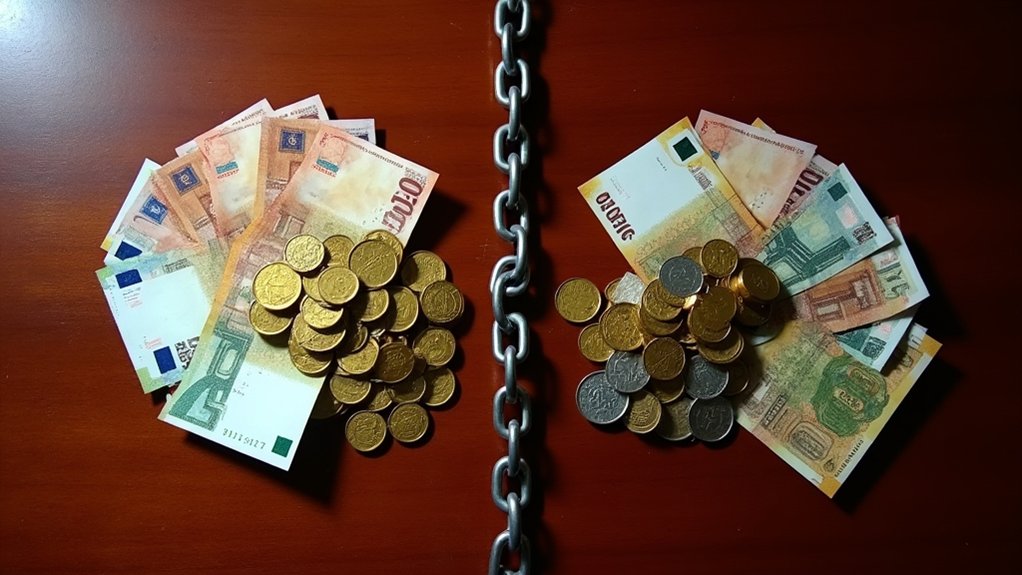

Money talks, and in 14 African nations, it speaks French—or at least it used to. The CFA franc, born on December 26, 1945, when France ratified the Bretton Woods Agreements, still circulates among 210 million people across two monetary zones. That's not a small number.
The CFA franc: a 1945 colonial artifact still shaping monetary policy for 210 million Africans across fourteen nations.
Eight West African countries—Benin, Burkina Faso, Côte d'Ivoire, Guinea-Bissau, Mali, Niger, Senegal, and Togo—form UEMOA. Six Central African nations—Cameroon, Central African Republic, Chad, Republic of Congo, Equatorial Guinea, and Gabon—make up CEMAC. Different regions, separate central banks, but the same currency value. The West African version gets managed by BCEAO in Dakar. The Central African variant runs through BEAC in Yaoundé. In the WAEMU zone, BCEAO and CREPMF work together to regulate both foreign exchange operations and securities markets.

Here's where it gets interesting. Both currencies are pegged to the euro at fixed rates. France still maintains partial control over issuance. The Bank of France has been printing CFA notes at Chamalières since 1945. Colonial ghosts linger in the machinery.
The acronym itself tells a story. Originally “franc of the French Colonies of Africa,” it morphed into “African Financial Community” and “Financial Cooperation in Central Africa.” Same initialism, different spin. Marketing matters.
The numbers paint a complex picture. West African UEMOA countries posted a combined GDP of $128.6 billion in 2018 with 105.7 million people in 2014. Central African CEMAC nations showed $114.3 billion GDP in 2023 with 62.8 million people. Not exactly economic powerhouses, but stable.
That stability is the whole argument, really. Proponents praise the CFA franc for preventing hyperinflation and maintaining low inflation rates compared to countries with volatile currencies. Fixed exchange rates provide predictability. Businesses can plan. Investors feel safer. During the 2020 public health crisis, the Franc Zone showed relative resilience with 0.3% growth while sub-Saharan Africa contracted 1.7%.
Critics see something else entirely. A currency partially controlled by a former colonial power, printed in France, pegged to European monetary policy. Independence with strings attached. The Franc Zone framework itself dates to the 1930s, before World War II even started. Member nations must hold at least 50% of their foreign reserves in the French treasury as part of the guarantee arrangement. Despite these constraints, both CFA francs remain active in Forex markets where traders analyze their dynamics alongside other African currencies.
Both variants carry the same abbreviation: F.CFA. They're theoretically divided into 100 centimes, though no such coins exist. Just another peculiarity in a system that defies simple judgment.