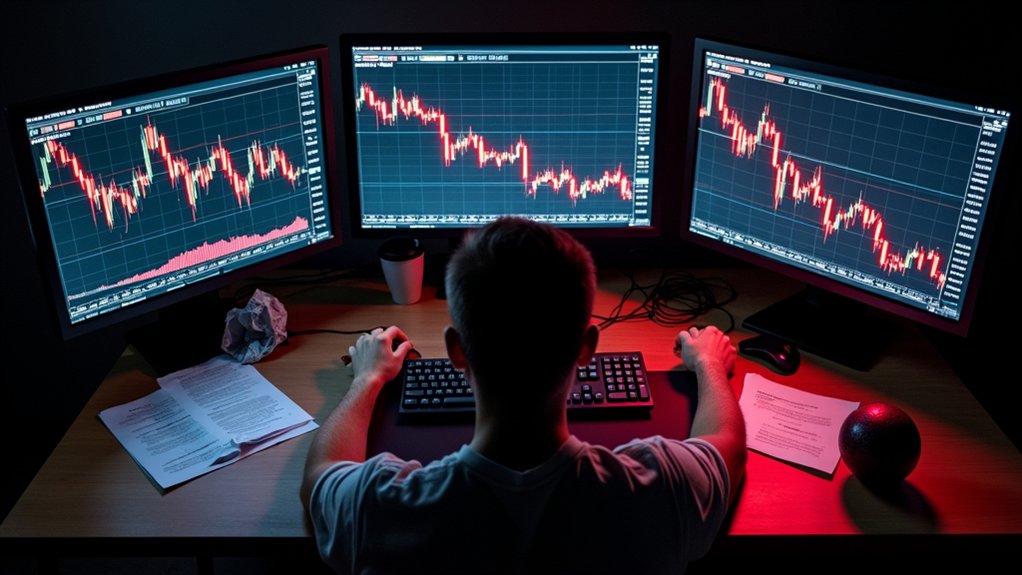

Trading biases aren't just annoying quirks—they're wealth destroyers. They silently erode accounts while traders remain blissfully unaware.
Anchoring bias fixates on purchase prices, turning rational humans into stubborn holders of losing positions. The original entry becomes sacred. Market conditions change, but the anchor holds firm. Some even adopt the Martingale strategy, doubling down to lower their cost basis. Classic mistake. Markets have no memory of what someone paid.

Confirmation bias makes things worse. Traders seek information that validates preexisting beliefs while conveniently ignoring contradictions. The result? Overconfidence. Selective memory. Poor outcomes. Opinions become self-reinforcing echo chambers.
Consumer choices fall into the same trap—placing excessive weight on confirming data while gathering either too little cheap information or too much costly information that doesn't matter.
The availability heuristic jumps in next. Recent events dominate decision-making. A big news story triggers overreaction. Risk perception gets skewed by whatever happened yesterday, not by actual probabilities.
Present bias compounds the problem, focusing disproportionately on the short term beyond mere impatience. The representativeness heuristic draws faulty analogies across unrelated situations.
Then there's herding. FOMO drives traders into crowded positions. Social acceptance feels safer than independent analysis. Emotion and instinct override logic. Prices inflate, bubbles form, crashes follow.
The social learning heuristic amplifies this tendency in financial markets, creating spectacular inefficiencies.
Escalation of commitment keeps traders trapped in losing positions. Previous investments justify throwing good money after bad. Self-justification, emotional attachment, and fear of admitting mistakes create a toxic combination.
Myopia and loss aversion cause frequent portfolio readjustments, with fear prompting premature exits from profitable trades. Trader psychology shapes these emotional responses, directly affecting how individuals interpret price movements and execute decisions under pressure.
The illusion of control convinces traders they can influence markets. Overconfidence follows. Random patterns get misinterpreted as controllable signals.
Sample size neglect draws sweeping conclusions from tiny datasets. The Law of Small Numbers creates overconfidence in short-term results and unreliable backtests.
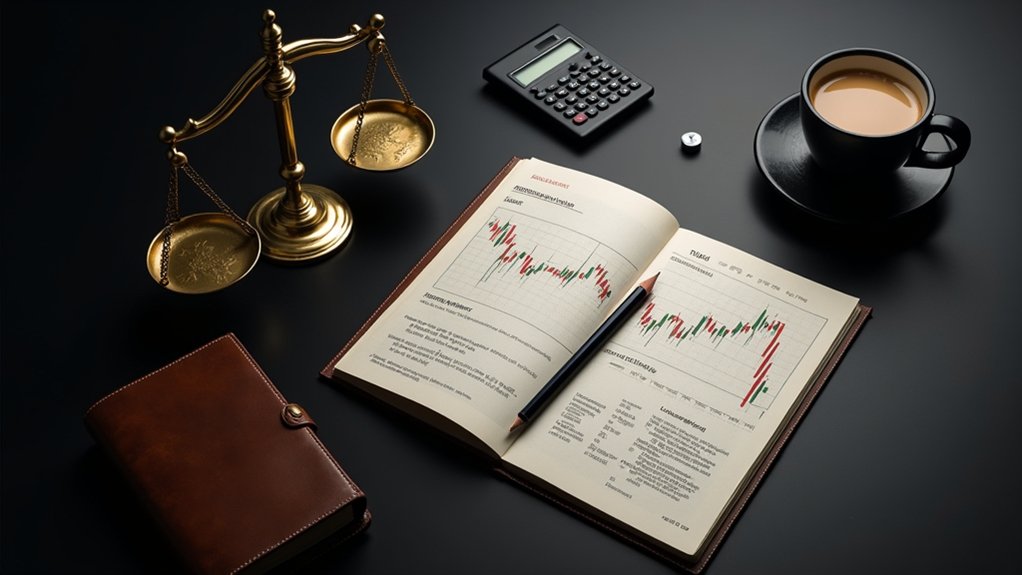
Data provides the antidote. Trade journals reveal patterns. Personal statistics—like a 70% win rate with 1:2 risk-reward—confirm positive expected value. Understanding realistic income expectations helps traders avoid overconfidence and set achievable performance targets based on actual market conditions.
Consistent data builds trust in the process, reducing second-guessing. A quantified edge overrides emotional impulses when real money hits the line. Systematic record-keeping transforms subjective hunches into objective evidence, allowing traders to identify which biases consistently sabotage their performance.