Uganda's forex market is booming—millions traded daily through offshore brokers—but there's a glaring problem: no domestic regulator is watching any of it. The Capital Markets Authority doesn't license forex brokers, the Bank of Uganda only oversees physical currency exchanges, and traders rely entirely on foreign oversight from places like Cyprus or Australia. Result? Over 1,000 people just lost roughly $13 million to scams exploiting this regulatory vacuum. Leverage hits 2000:1, fraudsters run wild on social media, and victims can't fight back across borders. The full scope reveals why this free-for-all continues unchecked.
Quick Facts That Matter
- Uganda has no domestic regulator for online retail forex trading, creating a dangerous regulatory vacuum despite no explicit ban.
- Over 1,000 investors lost $13 million recently to forex scams exploiting regulatory gaps and offshore broker operations.
- Unregulated brokers offer extreme leverage up to 2000:1, magnifying losses with zero investor protections like segregated client funds.
- Mobile money integration enables $5 deposits, making risky forex trading accessible to young, middle-class urban Ugandans via social media.
- Offshore broker operations make legal enforcement nearly impossible, leaving victims without domestic remedies when fraud occurs.
Overview: Forex Trading in Uganda
In the heart of East Africa, Uganda's forex market has been on a quiet winning streak that most retail traders probably haven't noticed. The Ugandan Shilling jumped 4.47% against the dollar between August 2024 and August 2025. June 2025 alone saw a 1.3% climb, pushing rates to Shs 3,605.84 per USD. Financial reforms, rising remittances, and export cash fueled the rally. Meanwhile, the Central Bank held rates at 9.75% since October 2024. Private sector credit hit Shs 2,311.19 billion in May 2025—49.4% higher than April. Business confidence soared above 50. Nobody's screaming about it, though. Like its regional counterpart, the Kenyan Shilling in forex markets, the Ugandan Shilling's movements reflect broader East African currency dynamics and trade relationships that shape the region's exchange rate stability.

Is Forex Trading Legal in Uganda?

The legal status of forex trading in Uganda sits in a weird gray zone that nobody seems keen to clarify.
The government hasn't banned it. There's no law saying “thou shalt not trade currency pairs online.” People just… do it.
But here's the kicker: Uganda's Capital Markets Authority doesn't license retail forex brokers. Zero oversight. No regulatory framework exists specifically for this stuff. This situation mirrors challenges in other African markets where currency exchange regulations remain underdeveloped. With no local licensing framework in place, Ugandan traders often turn to offshore brokers for market access.
Who Regulates Forex Trading in Uganda?

Nobody's watching the store.
Uganda's Capital Markets Authority doesn't regulate retail forex.
The Bank of Uganda? They supervise licensed Forex Bureaus—physical money changers—not online traders. No domestic authority oversees this market. Zero.
The Uganda Forex Bureau and Money Remittance Association (UFBMRA), with over 240 licensed members, represents physical forex bureaus and money remitters supervised by Bank of Uganda, but has no jurisdiction over online retail forex trading platforms.
So Ugandan traders rely entirely on foreign regulators. FCA in the UK. ASIC in Australia. CySEC in Cyprus. FP Markets holds licenses from ASIC, CySEC, FSCA, and FSA Seychelles. Moneta Markets operates under South Africa's FSCA (licence 47490) and Saint Lucia. The FSCA's regulatory framework ensures market integrity and trader protection for brokers operating under its jurisdiction.
It's self-regulation by necessity. Check your broker's foreign credentials yourself. Nobody local will do it for you.
How Forex Trading Works in Uganda

From a Kampala café or a Mbarara internet shop, retail traders tap into a $6.6 trillion daily machine.
They open accounts with international brokers—minimum $20 gets you in—because local outfits lack Capital Markets Authority licenses.
The mechanics? Buy USD/EUR if you think it'll rise, sell if you expect a drop.
USD/UGX trades exist but good luck finding platform support.
Leverage rockets up to 2000:1 with unregulated brokers, though sane jurisdictions cap it at 30:1.
Most brokers walk you through opening an account online with just ID verification and a funding method.
Profits? Taxable.
Up to 40% personally, 30% corporate.
Uganda Revenue Authority wants documentation.
Internet connection required.
Common sense optional.
Best Time to Trade from Uganda
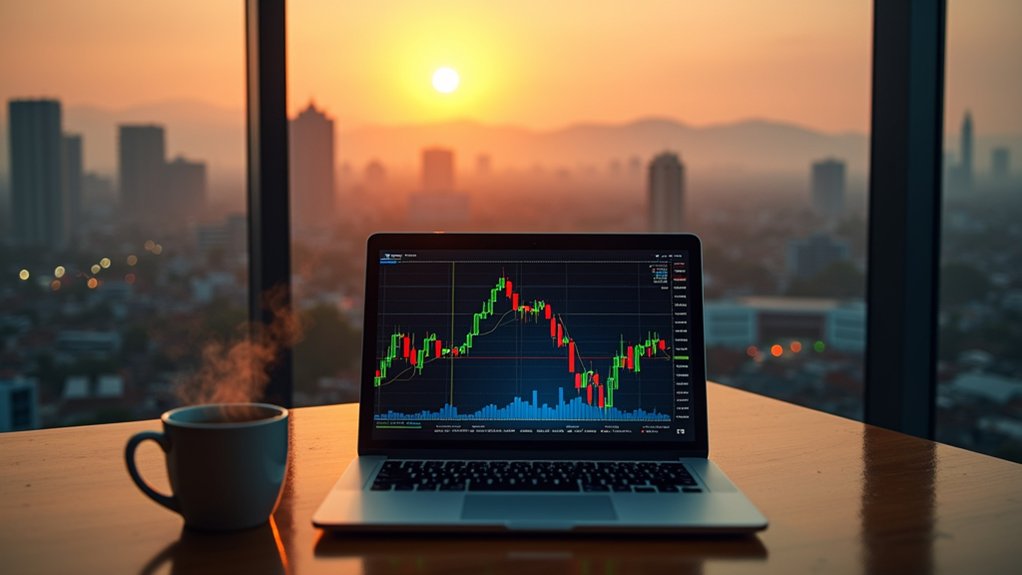
Knowing how the system works means nothing if a trader logs in at the wrong hour.
The forex market runs 24 hours through overlapping sessions—Sydney, Tokyo, London, New York—all converted to East Africa Time. London operates 10:00 AM to 7:00 PM EAT. New York runs 3:00 PM to midnight.
The magic window? 3:00 PM to 7:00 PM EAT, when London and New York overlap. That four-hour stretch delivers the highest volumes and volatility.
Tokyo's session offers calmer waters, lower volatility. London brings tighter spreads and serious liquidity. Understanding time-of-day effects helps traders identify when currency pairs show the most movement and the best entry points. These times assume 8:00 AM to 4:00 PM local trading hours in each market center. Timing isn't everything, but it's close.
Payments, Deposits and Withdrawals in Uganda
Moving money in and out of a forex account sounds simple until a trader sits down to do it.
Uganda's mobile money infrastructure—MTN and Airtel—changed the game in 2017 with interoperability.
Brokers like Exness, HFM, XM (Official Site 🔗), and Deriv accept mobile deposits starting at $5. Most withdrawals hit accounts within minutes, 24/7. No bank required.
Stanbic's Instant Money caps fees at UGX 1,500.
Platforms like TransFi use stablecoins for cross-border settlements linking Uganda to 40+ currencies.
The catch? Currency conversion matters when UGX isn't available. Cross-border traders often monitor the USD/KES exchange rate since Kenyan Shilling pairs are more liquid in East African forex markets.
Traditional banking suddenly feels ancient. The Lightning Network processes payments off-chain through payment channels, settling cross-border forex deposits in seconds at fractions of a cent per transaction.
Taxes, Reporting and Money Rules in Uganda
How does Uganda treat profits from clicking buttons on a London server? The tax code doesn't spell out “forex winnings” explicitly.
Uganda's Financial Intelligence Authority watches money flows through the Anti-Money Laundering Act, 2013.
Brokerages operating here must verify identity, determine beneficial ownership, and file Suspicious Transaction Reports when transactions look weird. They keep records ten years minimum.
Enhanced Due Diligence applies to Politically Exposed Persons. Compliance officers enforce internal programs.
The FIA collects every STR in a central database. Tipping off customers about investigations? Illegal.
The Uganda Securities Exchange requires dual reporting: disclosures mandated by another regulator must also be provided to the USE.
In neighboring Botswana, the Non-Bank Financial Institutions Regulatory Authority oversees forex brokers and foreign exchange activities with explicit regulatory frameworks.
The system prioritizes tracking money over clarifying tax treatment.
Forex Trading Scams and Risks in Uganda
Between February and the months that followed, Ugandan police logged more complaints about forex fraud than they'd ever seen before.
Over 1,000 investors lost roughly $13 million. Reilag Investments allegedly conned 700 people—each dropped Shs43.5 million. FX Salongo hit another 300.
Here's the kicker: Uganda has zero forex regulations. None. The Capital Markets Authority doesn't touch it. Kenya has rules; Uganda doesn't. So brokers manipulate CFD prices, rig repayments, operate without liquidity providers.
Young, middle-class city dwellers get targeted hardest. Social media spreads 32% of scams. Leverage reaches 2000:1. It's a regulatory vacuum, and fraudsters love it. Legitimate brokers in regulated markets maintain segregated client funds separate from operational capital, but Uganda's unregulated environment offers no such protections. Even when victims try to fight back, offshore broker operations make legal enforcement nearly impossible.
Quick Q and A
Can I Trade Forex Part-Time While Keeping My Regular Job in Uganda?
Yes, Ugandan traders can participate in forex markets part-time alongside regular employment. The 24-hour nature of global forex markets enables flexible trading schedules, allowing individuals to trade during evenings, weekends, or breaks without conflicting with daytime work commitments.
What Minimum Amount Do I Need to Start Forex Trading in Uganda?
Ugandan traders can start forex with zero minimum at brokers like HFM, though $100-200 USD is typical. However, financial experts recommend beginning with $200-500 USD to allow proper risk management and sustainable trading development.
Which Currency Pairs Are Most Profitable for Ugandan Traders?
Major pairs like EUR/USD, USD/JPY, and GBP/USD offer tighter spreads and higher liquidity for Ugandan traders. USD/UGX provides local relevance but requires swing trading strategies due to wider spreads and lower liquidity compared to major pairs.
Do I Need a VPN to Access International Forex Brokers From Uganda?
International forex brokers are generally accessible from Uganda without VPN requirements. Most reputable platforms operate openly in the region. However, traders should verify specific broker accessibility and make certain stable internet connections for reliable trading execution and platform performance.
How Long Does It Take to Become Consistently Profitable in Forex Trading?
Most traders require five or more months of focused practice to achieve consistent profitability, though industry data shows the average profitable trader has 5.4 years of experience before generating reliable, sustainable returns.
The Bottom Line
Forex trading in Uganda isn't illegal, but it's messy. The infrastructure's clunky, regulation's patchy, and scams lurk everywhere. Traders deal with payment headaches, unclear tax rules, and brokers who might vanish overnight. Some people make money. Most don't. The fantasy of quick wealth crashes against reality: capital controls, limited banking options, and zero local protections when things go sideways. It's possible, sure. Easy? Not even close.